
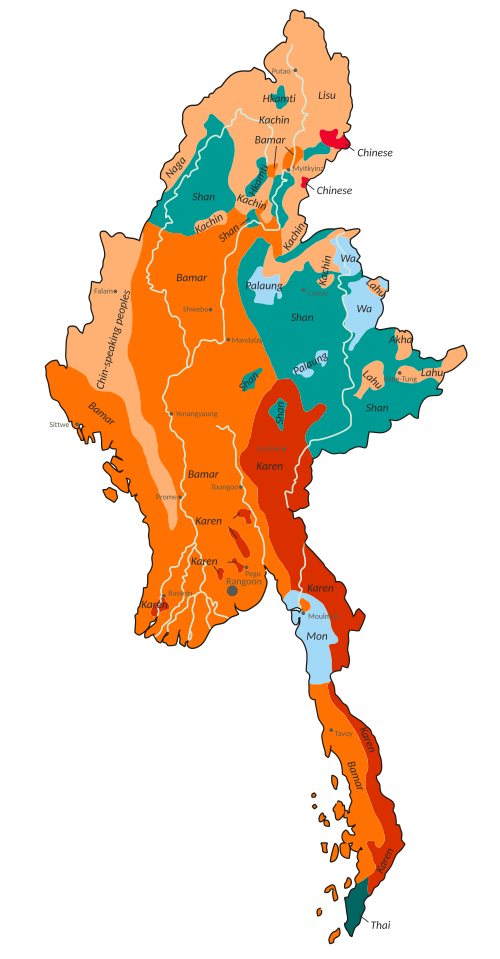
Myanmar is one of Southeast Asia’s most ethnically diverse countries. The Bamar, often described as the country’s dominant or state-forming ethnic group, constitute roughly two-thirds of the population. Both the names “Burma” and “Myanmar” are historically connected to the Bamar ethnonym. Most of the country’s ruling dynasties, political elites and, more recently, military leadership have been predominantly Bamar.
The largest minority communities include the Shan, Karen, Rakhine, Mon, Kachin, Chin and Kayah. Precise figures are disputed because census data are incomplete and ethnic identity is often politically sensitive.
Myanmar’s 1982 Citizenship Law established three categories of citizenship: the full, associate and naturalized. And made full citizenship dependent largely on membership of officially recognized ethnic groups or proof of ancestry predating before 1823.
Myanmar officially recognizes 135 ethnic groups, but this classification excludes several important communities, including people of Chinese and Indian descent and the Rohingya.
In regard of religious separation, Buddhism is practised by the overwhelming majority of the population and is particularly associated with the Bamar, Shan, Mon and Rakhine. Christianity is widespread among several minority groups, especially the Kachin, Chin and Karen, while Muslims and Hindus form smaller but historically significant communities.
Since independence in 1948, ethnic groups have fought for autonomy or independence. The China-linked Wa and Kokang regions remain largely self-governed, highlighting Myanmar’s limited control (the Myanmar army cannot enter this two territory) over its borderlands.
Who Are the Rohingya?
The Rohingya are a predominantly Muslim community originating from northern Rakhine State, historically known as Arakan. Their language is closely related to the Chittagonian dialects spoken across the border in Bangladesh. They are a minority in both ethnic and religious terms.
Their historical origins remain highly contested.
Rohingya representatives argue that they descend from Muslim communities that have lived in Arakan for centuries. Myanmar nationalist narratives generally portray them as immigrants from Bengal.
Historical evidence indicates both a centuries-old Muslim presence in Arakan and substantial migration from Bengal during the period of British colonial rule.
The dispute is therefore not simply about migration.
It concerns belonging, citizenship and competing interpretations of the region’s history.
The Burmese kingdom conquered Arakan in 1784–1785. The British East India Company subsequently defeated Burma in the First Anglo-Burmese War, and Arakan became part of British India in 1826. Colonial rule encouraged labour migration across what was then an internal imperial boundary. This contributed to growing tensions between Buddhist Rakhine and Muslim communities.
Statelessness and Oppression
During the Second World War, violence erupted between the two populations. Many Muslims supported the British, while sections of the Rakhine and Bamar nationalist movements initially cooperated with Japan. Thousands of people were killed or displaced.
As British rule ended, some Muslim leaders in northern Arakan sought either autonomy or incorporation into East Pakistan. After these efforts failed, a Muslim insurgency known as the Mujahid movement fought the Burmese government. Although this rebellion was largely defeated by the 1960s, it influenced later official claims that the Rohingya represented a separatist or foreign population.
The situation of the Rohingya deteriorated under the military rule (between 1962 and 2011 and since 2021).
Because the Rohingya were not recognized as one of Myanmar’s official ethnic groups, most were unable to obtain full citizenship. Large numbers consequently became stateless or lacked secure legal status.
Over subsequent decades, the authorities imposed severe restrictions on their freedom of movement, access to education and healthcare, employment, marriage and family life. Many could leave their villages only with official permission. Military operations and communal violence repeatedly forced Rohingya communities to flee to Bangladesh and other countries.
The Rohingya diaspora now extends across Bangladesh, India, Pakistan, Saudi Arabia, Malaysia, Thailand and Indonesia. Bangladesh hosts the largest refugee population.
The 2017 Crisis
In October 2016, the Arakan Rohingya Salvation Army (ARSA) attacked security posts in northern Rakhine State, killing nine police officers. In August 2017, ARSA carried out another coordinated series of attacks against the central government. Myanmar’s security forces responded with a large-scale military operation. Villages were burned, civilians were killed, and widespread rape and other serious abuses were reported.
More than 750,000 Rohingya fled to Bangladesh during and after the 2017 campaign. Most settled in overcrowded camps around Cox’s Bazar.
The United Nations described the operation as a “textbook example of ethnic cleansing,” while international investigators found evidence warranting the investigation and prosecution of senior military officials for genocide, crimes against humanity and war crimes.
Although ARSA committed attacks and was accused of abuses against civilians, the existence of an armed Rohingya organization did not justify collective punishment of the civilian population.
A Continuing Humanitarian Crisis
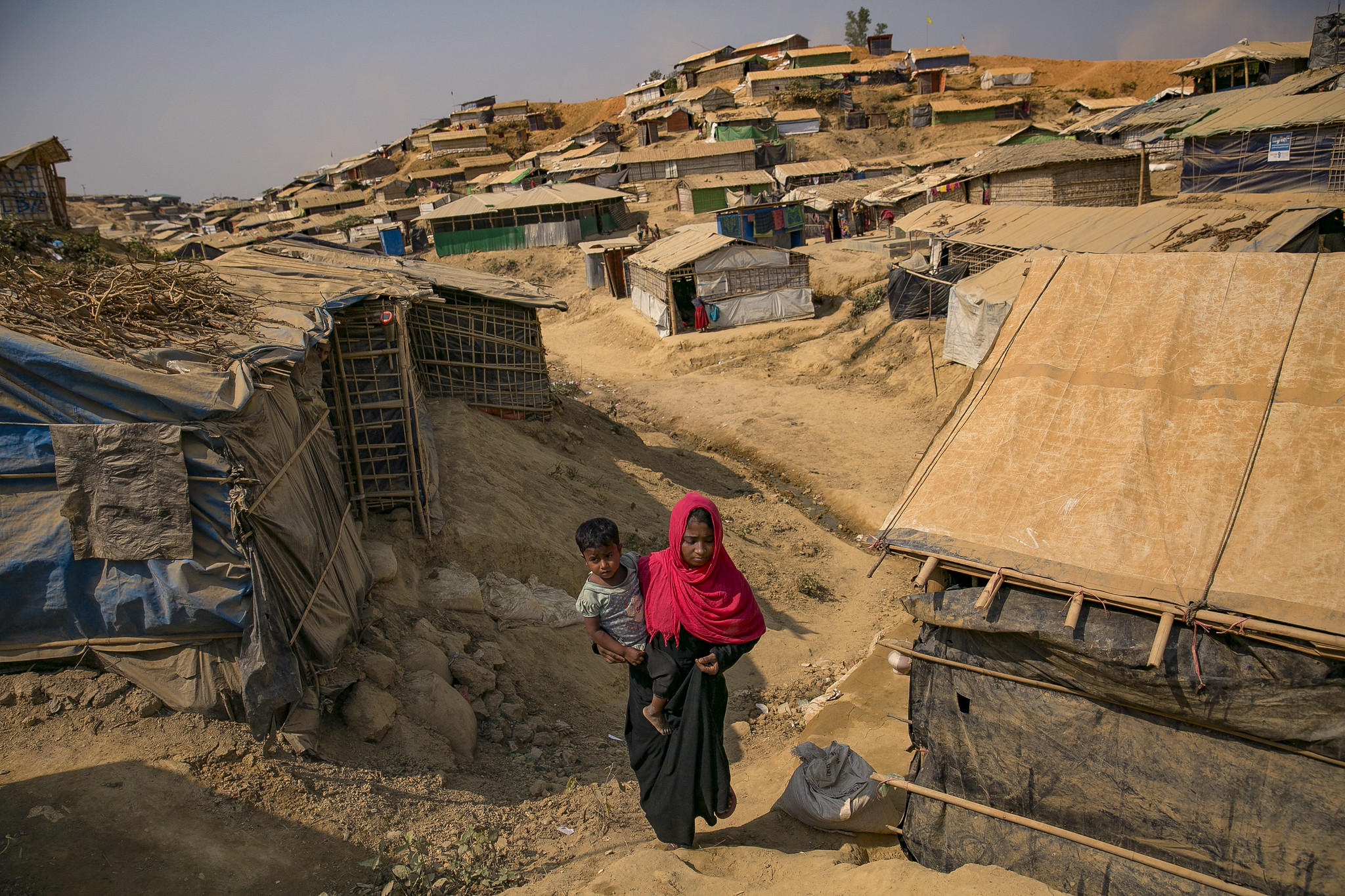
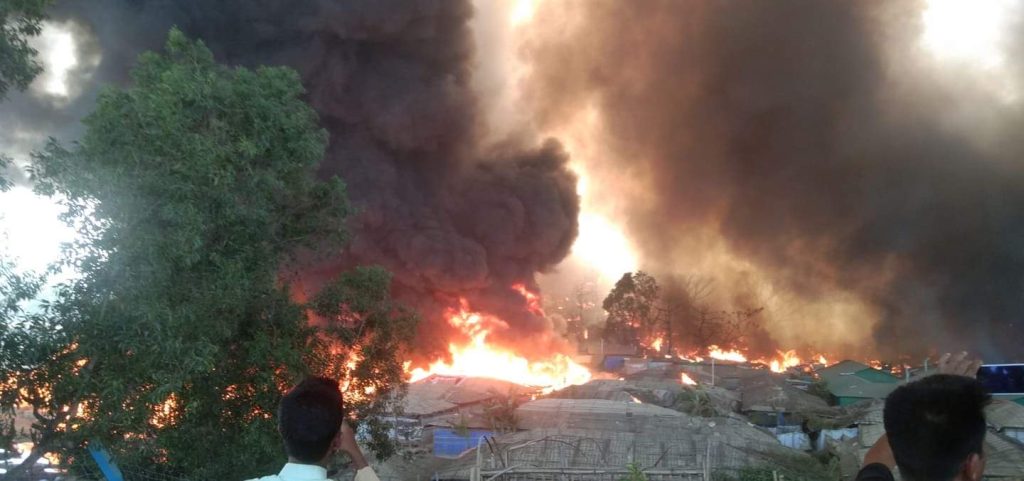
Rohingya refugees in Bangladesh live mainly in densely populated camps and remain highly dependent on international assistance. They face poverty, insecurity, restricted opportunities and the recurring threat of fires, floods and cyclones.
“The only difference is that in Bangladesh, no one comes to massacre them. But rape happens there too. A frightening number of people are in need of urgent humanitarian aid, and not just that: the majority of these women watched their families being killed, most of them were tortured, raped, mostly in groups, and by now they are psychologically completely shattered,” said David Verberckt, a photographer who have been photographed the Rohingyas, in 2017.
At the same time, those remaining in Myanmar continue to experience severe restrictions and periodic violence.
The crisis cannot be resolved through repatriation alone. A sustainable solution would require guarantees of safety, freedom of movement, access to public services and a credible path to citizenship. Until these conditions exist, the Rohingya will remain one of the world’s largest stateless populations and Myanmar’s most serious unresolved ethnic and humanitarian crisis.
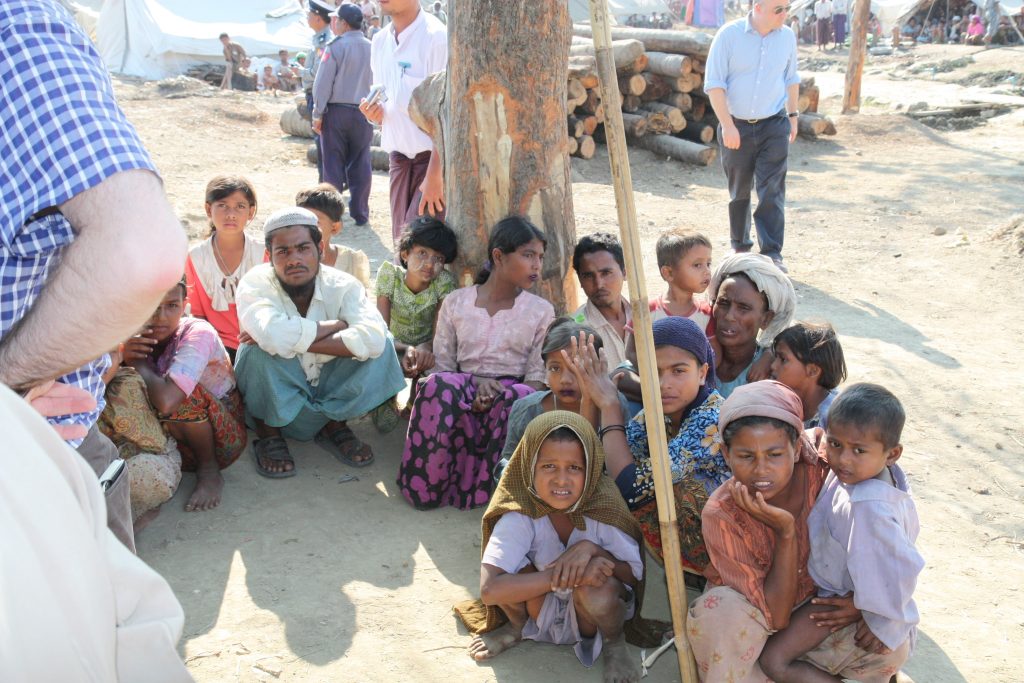
According to IOM Rohingya refugees remain in protracted displacement eight years after arriving in Bangladesh. Despite regional progress, including work rights for long-staying refugees in Thailand, conditions for voluntary and safe return remain limited.
Currently there are over one million registered Rohingya refugees living in Bangladesh
Over the past nine years, the Rohingya have experienced mass violence, expulsion, and prolonged statelessness. UN investigators concluded that the military’s actions showed genocidal intent, although Myanmar rejected that accusation.
International accountability efforts followed: The Gambia filed a genocide case at the International Court of Justice, and the ICC investigated alleged crimes against humanity connected to the refugees’ deportation.
The Rohingyas’ situation has not been resolved. Myanmar’s 2021 military coup and renewed warfare in Rakhine State made safe repatriation increasingly unlikely, while Rohingya remaining there were caught between the military and the Arakan Army.
In Bangladesh, more than one million refugees have faced restrictions on movement and employment, fires, insecurity, declining aid, and worsening hunger.
Some have attempted dangerous sea journeys to other Asian countries, leading to many deaths and disappearances. By July 2026, the international court cases were continuing, but the Rohingya still lacked citizenship, adequate protection, and a realistic path home.
