

While the UK struggles with surging numbers of illegal migrants arriving at their shores, the European Border and Coast Guard Agency, Frontex, reported a 20% drop in illegal crossings in the first half of 2025 at the EU’s external border.
The agency recently began operating outside EU borders, which, along with the “stronger prevention efforts by departure countries” to address sources of migration waves, intended such an outcome.
The Numbers
Between January and June of 2025, according to preliminary data from Frontex, 75,900 crossed the external EU borders illegally; the same period in 2024 brought 95,293 illegal crossings.
Frontex monitors three routes across the Mediterranean, two land borders at the Western Balkan route and at the Belarus-Lithuania border, as well as a northern seventh at the English Channel. This year’s report says the numbers to the east all dropped significantly, with the highest drop of 53% occurring at the Western Balkan route. In the South, the Western African route also dropped significantly, by 41%.
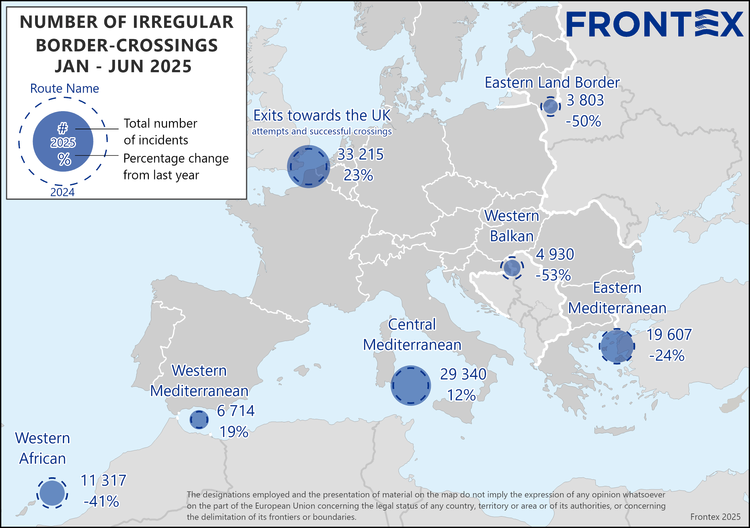
The Mediterranean routes continue to be the busiest, reporting a 19% rise across Southern Spain and a 12% rise by Italy. Libya and Algeria have emerged as the main departure states, each producing an 80% surge compared to last year. Though the Eastern Mediterranean route has seen a decrease of 24%, the emergence of the Libya-Crete corridor has seen significant movement and now accounts for the highest number of crossings on the route.
The Mediterranean routes together account for 638 migrant deaths in only 2025 so far, according to the International Organization for Migration (IOM). The rest of the routes together account for only 31 deaths so far.
The Channel route was responsible for a 23% increase in crossings compared to last year, rising to 33,215, which includes successful crossings as well as failed attempts. Smuggling networks operate widely in the area, utilizing simultaneous launches as well as new tactics to increase their success rate. These crossings, however, are increasingly dangerous as well.
Expansion to Keep Momentum
One of the EU’s most major crises began in 2015 with the Migration Crisis; ever since, the issue has remained controversial and in constant discussion. Recently, it has become instrumental for national governments’ victory as well as collapse.
The issue remained so central that Denmark has pledged to toughen migration laws even more during their six-month presidency of the Council of the EU, and the Council is not the only one to take steps in this direction.
Henna Virkkunen, European Commission executive vice president responsible for technology, told POLITICO in an interview that with the security threat becoming a cross-border issue and increasingly digitalized, the EU must prepare to go further than individual national responses.
Thus, the Commission called for an increase of the initial plan of expansion to increase the standing corps personnel to 10,000 by 2027, proposing an increase to 30,000 personnel instead.
The European Parliament remains divided on the issue, which slows down the implementation of legislation. Though right-wingers, such as Italy and Poland, would tighten laws, central leftists are hesitant to do so.
“It is challenging Europe, affecting people’s lives and the cohesion of our societies,” Frederiksen said, adding that citizens have the right to feel safe in their homes. “That is why we need to strengthen our external borders.”

One thought on “FRONTEX: Drop in Illegal Crossings in 2025”