
The Trump administration is using third-country deportations as a legal loophole to indirectly force asylum seekers back to their home countries.
As The Guardian revealed, in late August, around 20 people were sent to Liberia by planes from the U.S. Six individuals, including four Cubans, one Brazilian, and one Cameroonian refused to disembark in Monrovia; some of them were allegedly assaulted by ICE agents, who returned them to the plane and promised they would be taken back to the U.S.
Instead, a few hours later, they were dropped off in Equatorial Guinea, where armed men took them to a former luxury hotel turned detention centre in the capital, Malabo, where they have been held ever since. The deportees face two options: indefinite detention at the hotel or being sent back to their countries of origin, as has already happened to almost half of those who have arrived since November.
The action was as part of one of the largest third-country deportation arrangements of Donald Trump’s second term.
However, according to the monitoring project, Third Country Deportation Watch, many of these individuals had previously been granted withholding of removal by U.S. immigration judges who found that they faced a real risk of persecution, torture or death in their home countries.
How Do the Third-Country Removals Work?
Immigration lawyers claim that the Trump administration is using third-country deportations as a legal loophole to push asylum seekers back to their home countries.
The term is used to refer to any scenario in which the government transfers someone to a country other than the one they lived in previously to arrive in the United States or to a country of which they are a citizen or national.
According to the American Immigration Council, a “third-country removal” occurs only once a person is formally ordered removed from the United States.
It can also apply to those who are expelled from the United States without going through a formal removal process, leaving them with no grounds to seek asylum or other forms of relief. The US government is prohibited from deporting individuals to countries where they will face persecution, torture, or harm. However, third-country removals have become a key tool for implementing aggressive deportation policies.
The Trump administration even utilizes it to keep detainees in foreign prisons indefinitely.
The 1951 Refugee Convention and the United Nations Convention Against Torture stipulate which countries persons cannot be deported to, particularly those where they are likely to face persecution or torture.
Separately, the bill establishes a process for identifying where someone should be deported after a removal order has been issued. Immigrants awaiting removal are legally entitled to choose the nation to which they will be deported. The United States government has the authority to override this decision and deport them to a country that will accept them.
On What Grounds Take Third Countries Deportees?
The Trump administration has created a series of formal bilateral agreements and behind-the-scenes deals that send asylum seekers, refugees, and other immigrants to countries in which they face mistreatment, imprisonment and possible expulsion to the very countries from where they initially fled.
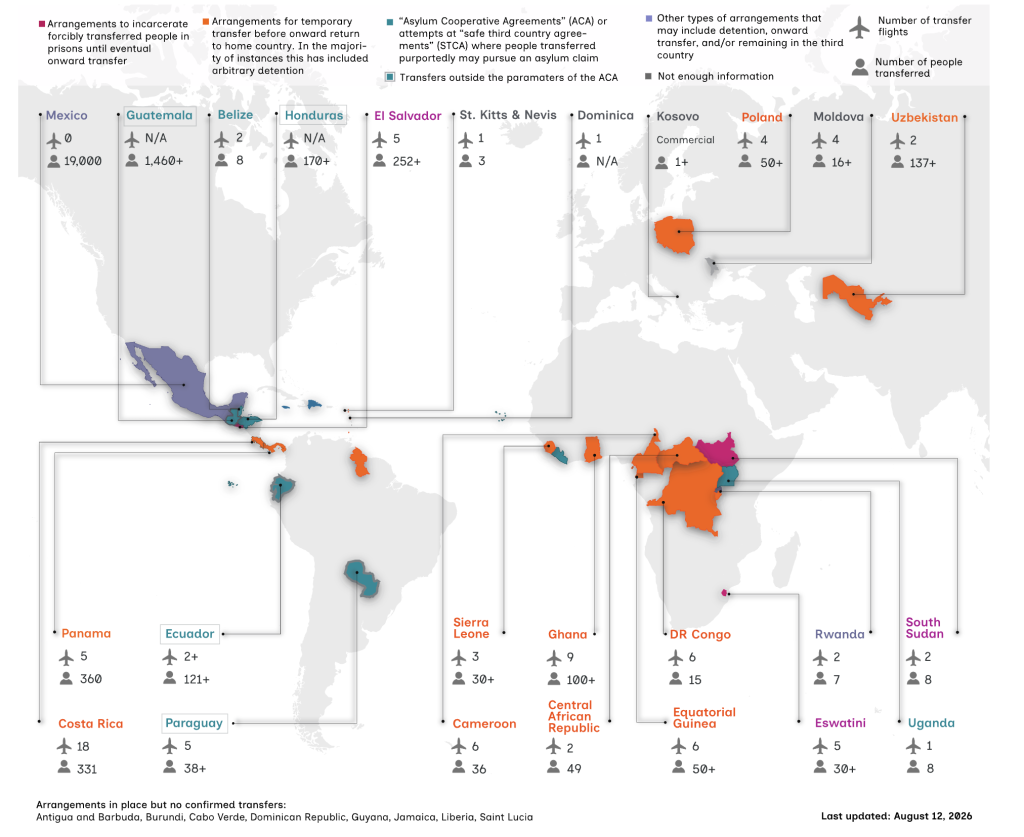
Since January 2025, the Trump administration has entered into third-country transfer agreements with over 35 countries.
These agreements and arrangements are as follows:
A) Asylum Cooperative Agreements (ACA) or Safe Third Country Agreements (STCA)
Accords with foreign countries to take deportees from elsewhere are sometimes mistakenly referred to as “safe third country” agreements.
In theory, when using a safe third country agreement, the United States government is obligated to determine that the immigrant will not be persecuted in that country and that they will have access to a “full and fair procedure” to claim asylum or equivalent protection.
The U.S. has signed the STCA with the governments of Belize, Cabo Verde, Canada, Ecuador, Guatemala, Honduras, Liberia, Paraguay, and Uganda.
B) Arrangements for temporary transfers
Cameroon, Central African Republic, Costa Rica, the Democratic Republic of the Congo, Equatorial Guinea, Ghana, Panama, Poland, Sierra Leone, and Uzbekistan made arrangements with Washington to serve as temporary transit points before the persons’ repatriation to their respective home countries. In the majority of instances this has also included arbitrary detention.
C) Arrangements to incarcerate forcibly relocated individuals
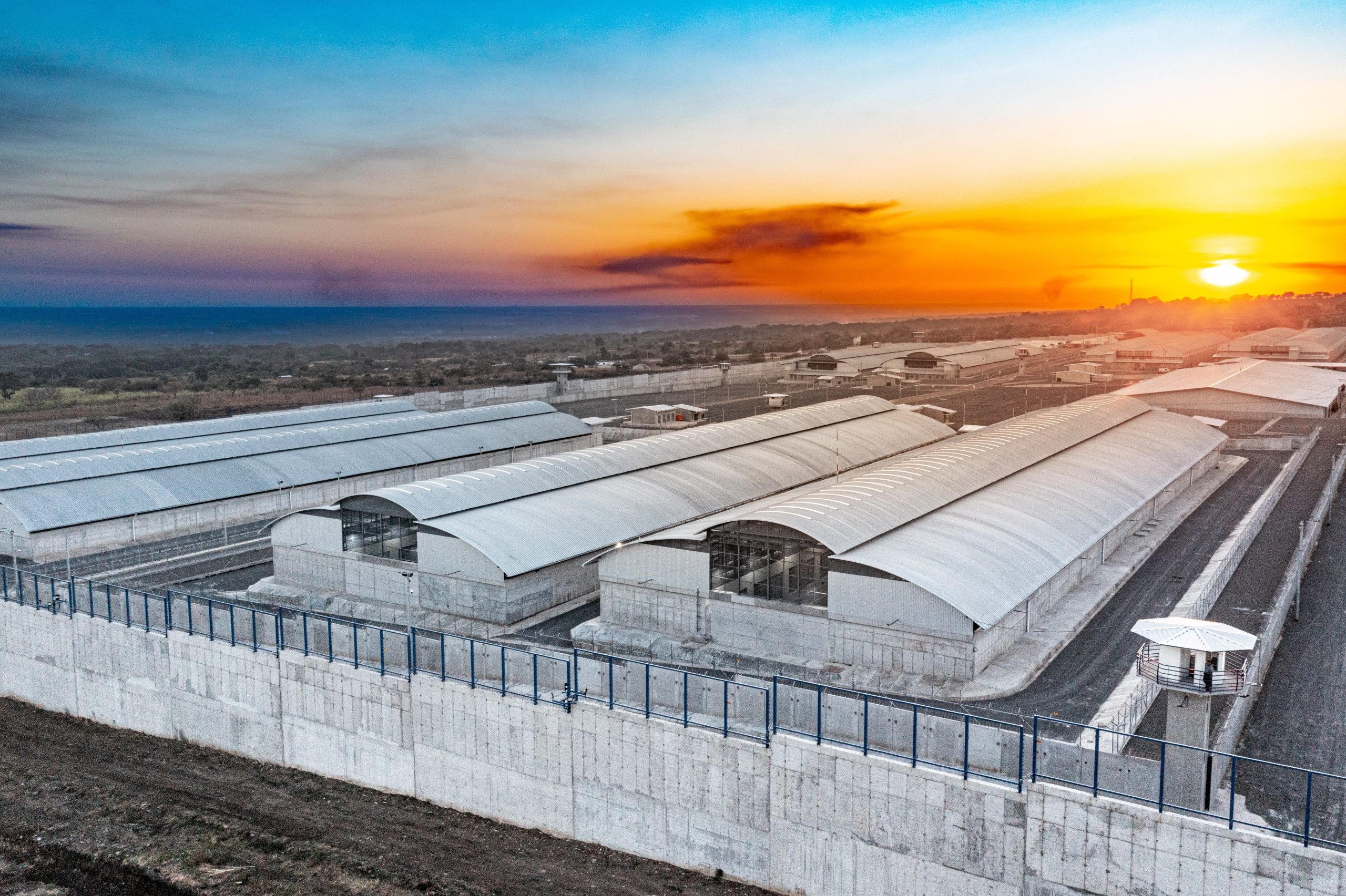
These deportees are being held in prisons in El Salvador, Eswatini, and South Sudan before being sent elsewhere.
This is the most severe kind of forced deportation procedure.
Its legal ground dates back to March 2025, when President Trump invoked the long-dormant Alien Enemies Act, which provided that the Venezuelans who were deemed to be members of the gang Tren de Aragua, could be immediately expelled from the United States without due process.
Subsequently the government sent hundreds of Venezuelans to El Salvador, in possible violation of a court order, where they were held in the infamous prison known as the Terrorism Confinement Center (CECOT). Whether El Salvador ever intended for them to be released is unclear, and Trump administration officials said they would never return to the United States. Eventually in June 2025, they were sent back to Venezuela. After sending hundreds of Venezuelan men to be imprisoned, the U.S. Department of State gave a $4.7 million “grant” to the government of El Salvador.
D) Other kinds of arrangements
These deals may include detention, onward transfer, and/or remaining in the third country, such as Mexico, Rwanda and Costa Rica. Many of the countries that originally signed an ACA subsequently also agreed to receive forcibly transferred third-country nationals outside the parameters of the ACA.
Where Were the People Sent?
Data compiled by Human Rights First and Refugees International indicates that in addition to the countries where agreements have been signed but no removals have been confirmed, most of the countries that have accepted removal flights (with the exceptions of Mexico and Ecuador) have accepted no more than three as of spring 2025. At most, those countries have accepted a few hundred deportees, with many receiving only a few dozen; at least nine of them accepted none.
According to the sources of the Third Country Deportation Watch as of mid-2026, the U.S. administration has used third-country agreements to send over 22,000 to 23,000 individuals to at least 26 different countries.
With the exception of Mexico, which has taken around 19,000 people from elsewhere in the Western Hemisphere, third-country removals have happened at small scale.
Are the Third-Country Deportations Illegal?
The Trump administration argues that it only sends people to other nations after receiving “diplomatic assurances” that they will not face persecution or torture. However, in several cases, they have specifically transferred prisoners to nations with jail systems infamous for torture and other human rights violations. The Venezuelan men dispatched to CECOT have confirmed this.
In a March 2025 lawsuit, a federal judge determined that the Trump administration’s policy on third-country removals were unlawful. However, the verdict has been stayed while the issue is appealed.
Regarding some of the transfers, it has also been established that the Trump administration illegally used the Alien Enemies Act in response to an alleged “invasion” of persons seeking refuge.
