
Modern refugee protection grew from a global effort to make sure people fleeing persecution would not be left with nowhere to go. In contrary, for much of its past, the United States excluded immigrant groups based on race, ethnicity, and national origin. Asylum protection emerged against that contradiction.
The U.S. Asylum System Was Built Out of the Ruins of World War II.
President Donald Trump’s border strategy is not just about building a wall, hiring more Border Patrol agents, or increasing deportations. The real foundation is asylum restriction.
In 1891, Congress founded the Bureau of Immigration to manage the admission of immigrants, including those labeled “refugees”. Then, the turmoil generated by the 1911 Mexican Revolution drove people to the U.S.-Mexico border. Most of them were reviewed and accepted for permanent residence by Immigration Bureau personnel, who allowed for “humane considerations” when interpreting these regulations.
The Immigration Act of 1917 was the first large impediment to the entry, forcing all immigrants aged 16 years and older to demonstrate they could read. In the 1920s the quotas came: the Emergency Quota Act of 1921 and the Immigration Act of 1924 imposed strict limitations (quotas) on how many immigrants the U.S. would admit from every country each year. Immigrants from northern and western Europeans were admitted much easier, and it made the procedure difficult for immigrants from the rest of Europe and other nations.
Under a presidential directive issued Dec. 22, 1945, President Truman authorized displaced persons and refugees to receive expedited entrance into the U.S., within the context of current immigration law.
The Refugee Act of 1980 drew primarily on the 1951 Refugee Convention and its 1967 extension. America signed the latter. The majority of the Act was committed to developing a mechanism for resettling refugees who demonstrate a “well-founded fear of persecution”.
Lawmakers were reacting to the Cold War, with a focus on Eastern Europeans and Vietnamese fleeing communism. Territorial asylum (claims filed by those already in America or at the border) was an afterthought.
Policymakers quickly realised they had a problem. During the Mariel boatlift, which began weeks after the measure was signed, more than 100,000 Cubans left for Florida.
When people in need arrived at America’s borders, the country was suddenly forced to make a decision. It was not until the 1990s that the Clinton administration eventually streamlined the asylum application process and employed more asylum officers and immigration judges to help clear a building backlog.
Prior to 1994, asylum claims were often intertwined with deportation hearings. The Clinton-era regulations created a specialized corps of asylum officers under the former Immigration and Naturalization Service (INS) to interview applicants in a non-adversarial setting.
It worked for a time. However, the burden on America’s asylum system grew until, under Joe Biden, Customs and Border Protection documented about 300,000 migrant interactions at the southern border in one month alone.

Some migrants were fleeing persecution as defined by the Refugee Act, while others were fleeing gang violence or unstable economies. Asylum was not guaranteed, but applying provided a way to come to America and work for a while.
The Pushback Against Border Chaos Propelled Donald Trump’s Second Coming
Two ongoing court lawsuits will either support or undermine the president’s initiatives. In Mullin v Al Otro Lado, the Supreme Court will shortly rule on whether “metering,” or turning away migrants at the border, violates America’s asylum obligations.
Barack Obama was the first president to do it, but the practice was adopted by the first Trump administration. Any migrant who is “physically present” or “arrives in” the nation may claim for asylum under the legislation.
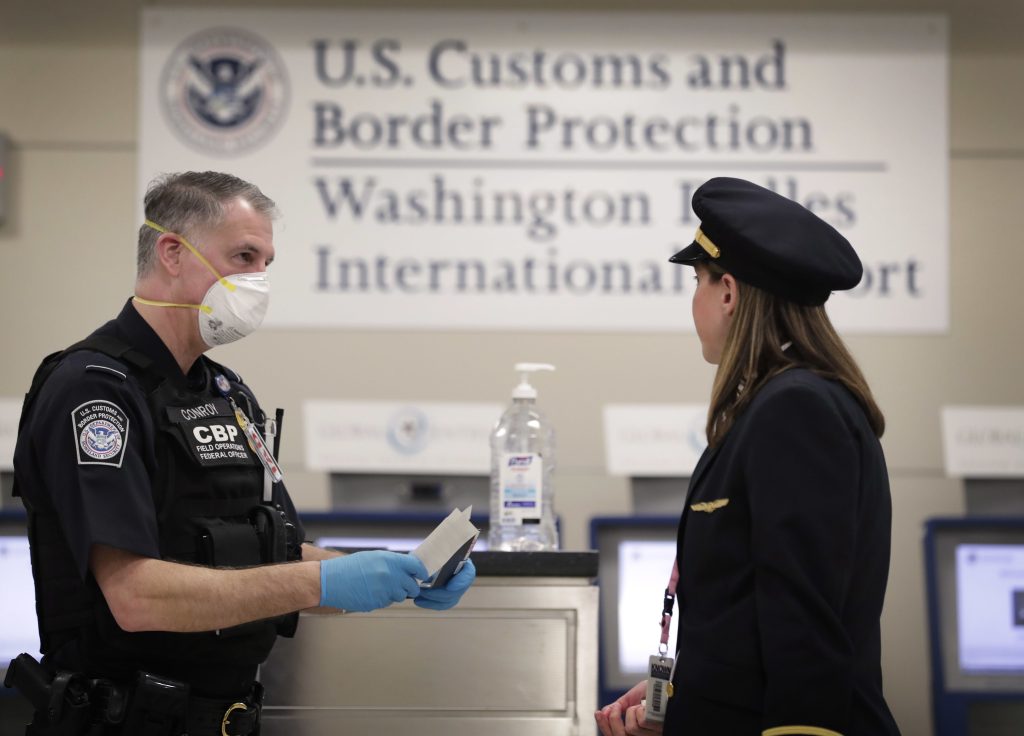
During oral arguments, the justices appeared to agree with the Trump administration that a non-citizen has not arrived until they have completely crossed the border.
That interpretation would permit metering.
The more relevant case is RAICES v Mullin, which appears destined for the Supreme Court. ¬This case challenges the Trump administration’s January 2025 proclamation suspending asylum processing at the southern border.
On his first day in office, President Trump stated that border instability constituted an “invasion,” allowing him to “suspend the entry of all aliens,” including asylum applicants.
In April, a federal appeals court in Washington, DC, overturned President Trump’s proclamation, claiming that “Congress did not intend to grant the executive the expansive removal authority it asserts.”
If and when the Supreme Court takes up the case, it will defer to the president’s contention that a certain immigration policy is a matter of national security.
Immigration Courts Under Trump’s Influence
If the courts rule that President Trump has overreached, his asylum ban will be weakened, but not destroyed. America’s immigration courts are not part of the independent judiciary system, however they operated by an agency of the Department of Justice.
Migrants who cross the border to claim asylum will still be processed in immigration courts presided over by judges who serve Trump’s agenda.
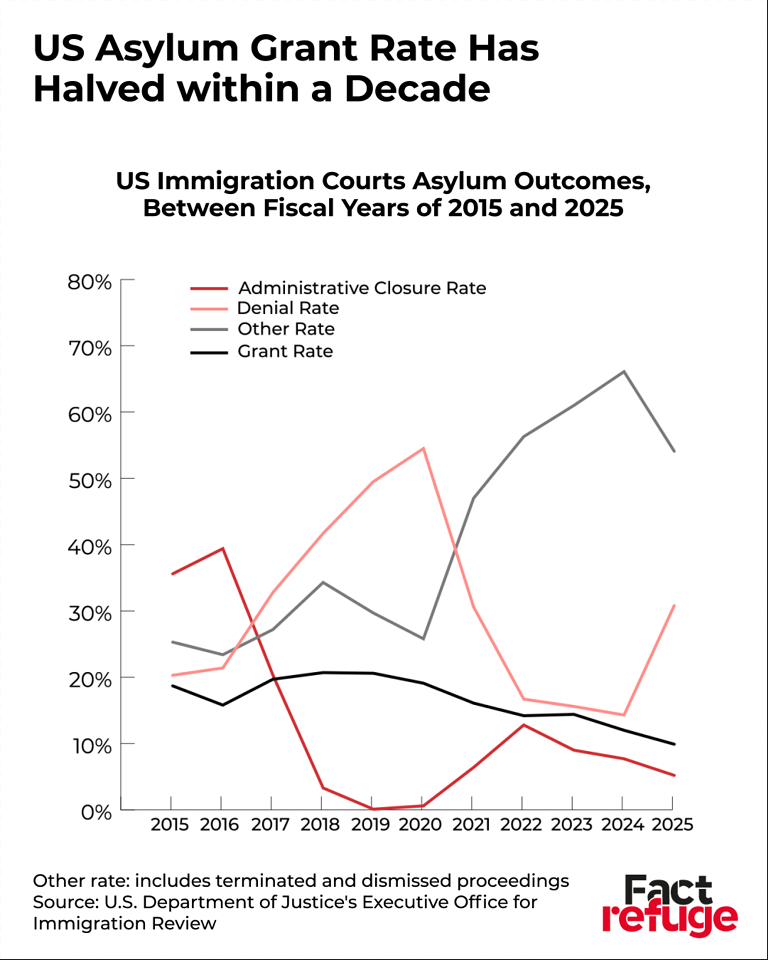
TracReports stated in November 2025 that over the last year, the Immigration Court’s asylum grant rate has been cut in half. They added, “the grant rate had been 38.2 percent a year earlier in August 2024. In August 2025, just 19.2% of refugee seekers were given asylum.”
Only 5 percent of asylum petitions were approved in March, down from January 2025. Depending on where those migrants come from, their applications may also be frozen forever.
In the interim, they will be held in overcrowded detention camps, where at least 18 people have died this year.
Immigration Crackdowns and Aid Cuts Reshaped Migration Across Central America
In the 2010s, the United States has seen a sharp rise in asylum applications from Mexicans and Central Americans devastated by structural violence committed by state and nonstate actors, such as transnational criminal organizations trafficking drugs, weapons, and people. In some instances, U.S. foreign policy focused on drug interdiction and suppressing opposition to U.S. economic interests, including funding for the militarization of police and paramilitary forces, has only increased conflict.
By fiscal year 2017, denial rates had risen sharply. Mexican asylum seekers saw especially high rejection rates, and applicants from El Salvador, Honduras, and Guatemala also faced steep denials.
Historically, the above mentioned countries also known as the Northern Triangle countries were primary migratory hubs, with large-scale emigration to the United States and, to a lesser extent, Mexico.
These movements were shaped by the legacies of civil conflict, structural poverty, gang violence, and inadequate state protection, and they were accompanied by long-standing patterns of return, frequently via deportation.
Since 2024, increasingly restrictive US immigration policies—including closed asylum pathways, accelerated deportations, and the termination of various Temporary Protected Status (TPS) designations and a parole program for Cubans, Haitians, Nicaraguans, and Venezuelans—have significantly reduced irregular northward movement.
These policies, combined with efforts to reduce transit through routes such as the Darien Gap, changed migration once again. Guatemala, Honduras, and Panama reported between 89 percent and 97 percent less irregular migration in the first quarter of 2025 than in the same period in 2024, while US authorities encountered 79 percent fewer unauthorized migrants at the southern border in fiscal year (FY) 2025 than in FY 2024, reaching the lowest levels in decades.
Conclusion
Asylum seekers may try to wait out the Trump administration. However, there is no guarantee that a future administration will be lenient. Democrats have been scarred by former President Biden’s immigration failures and have spoken out more strongly about border security.
The Laken Riley Act, enacted last year, makes it simpler for state attorneys general to sue the federal government over immigration laws. Texas, for example, would not hesitate to sue President Newsom or Ocasio-Cortez if they began releasing border crossers from custody. Finally, a clever provision in the One Big Beautiful Bill Act caps the number of immigration judges at 800, preventing the court system from expanding to handle more asylum cases.
The modern legal framework defines refugees as people who fear returning home because of persecution based on race, religion, nationality, political opinion, or membership in a particular social group. That standard became central to U.S. asylum law.
The history of asylum in the U.S. is not just a story of protection. It is also a story of exclusion, politics, and unequal recognition. The question has always been: whose fear counts?
