

As the US Immigration and Customs Enforcement (ICE) raids continue and tension mounts between the federal government and its people, protesters attempt to stop enforcers by making noise outside their hotels or refusing to house them in the first place.
As the situation escalates, it becomes clear that ICE is not simply controversial but, in many ways, goes against the very foundation of American patriotism it claims to be protecting. As the argument continues, businesses close amid the disruption, causing state-wide effects.
The situation is unique for a number of legal and practical reasons which we aimed to list and elaborate on.
Arrests Utilize Unconstitutional Means
Just last week, the Associated Press obtained an internal ICE memo from a whistleblower that explains that officers may be allowed to force entry into any residence without a judicial warrant.
https://apnews.com/article/ice-arrests-warrants-minneapolis-trump-00d0ab0338e82341fd91b160758aeb2d
Experts have highlighted that the officers must still have an administrative warrant; however, these are issued by ICE itself. The agency’s frequently asked questions site lists such warrants: Form I-200 for arresting suspected violators of immigration laws and Form I-205 to authorize removals with final orders.
So, while arrests and removals are executed solely under ICE’s authority, entering a home forcefully is an act that should require an external judge-signed warrant – in accordance with the 4th Amendment, providing US citizens protection against unreasonable search and seizure – but has been sidelined.
The memo is said to have not been widely distributed within ICE but has been used in the training of new agents. But it has seen practical use in Minneapolis, where the door to the home of Teyana and Garrison Gibson was broken by a battering ram ICE used to enter for the deportation of Garrison, a Liberian national who for years had reported for regular check-ins with ICE.
Teyana was handed an administrative warrant and received no answer on whether there was a judicial one.
DHS officials have refused to answer questions about where and when administrative warrants are used.
Using Children as Leverage
Another questionable tactic is how ICE handles children whose parents are to be deported. These minors usually go into detention with their family when detained by ICE. A 1997 settlement, known as Flores, stipulated that a judge must monitor whether children are protected in detention and that their needs are met. A federal court interpretation of Flores led to the general rule that children should not be in detention for more than 20 days.
A recent analysis by The Marshall Project of Immigration and Customs Enforcement data obtained by the Deportation Data Project revealed that since the second Trump administration returned to family detentions, at least 3,800 children under age 18, including 20 infants, have been detained.
While the data showed a spike in detentions at the 20-day duration mark, there were significant cases that were granted release later than this. Former Department of Homeland Security staffers indicated that the government detains families for as long as possible to encourage voluntary deportation or increase the likelihood of their deportation happening directly from the detention facility.
In a lawsuit regarding the state of facilities detaining families, parents alleged that they were denied child-friendly food, while others testified they received food contaminated with mold and worms.
“The food they gave us was not edible,” a mother of a 5-year-old girl from Chicago said in court documents about the Dilley Immigration Processing Center in Dilley, Texas. “We didn’t eat anything for days. They didn’t even give us water to drink.”
Others described children fainting from lacking food and vomiting from stress.
“It’s just such clear evidence that the goal of this administration is to create as much pain as possible to the most vulnerable people in the hopes that that will mean they can more easily carry out whatever their deportation goals are,” Becky Wolozin, an attorney at the National Center for Youth Law who works on the Flores settlement representing children who have been detained by ICE, told The Marshall Project.
This is not the only case in which children were involved in detention operations.
During the Minneapolis raids last week, a 5-year-old boy arriving home from preschool was detained along with his father and sent to a detention facility in Texas. Liam Conejo Ramos was taken from a running car in the family’s driveway and then told to knock on the door to his home to see if anyone was inside. Columbia Heights Public Schools Superintendent Zena Stenvik told reporters they were “essentially using a 5-year-old as bait.”
Department of Homeland Security spokesperson Tricia McLaughlin said in a statement that “ICE did not target a child,” and in fact, agents remained with the child while his father fled on foot, abandoning him.
The father, Adrian Alexander Conejo Arias, wanted to leave his child with another adult living in the home, but agents refused to leave the child, according to Stenvik’s report of the incident. Liam is now in a family holding cell with his father in the Dilley detention facility.
Most Deaths in Detention in 2025
Grueling surroundings could be behind what many have called deliberate neglect in detention facilities, which shows on the number of deaths in detention as well.
The year 2025 brought a tragic record; 32 people died in ICE custody, making it the deadliest in years. Only 2004 yielded such a high result, with the exact same count.
The cause of death differs for each person, but there is a general sense that illnesses are ignored in detention facilities and that conditions contribute to contracting germs in the first place.
“This is a result of the deteriorating conditions inside of ICE detention,” Setareh Ghandehari, advocacy director at Detention Watch Network, a non-profit monitoring immigration detention death, told The Guardian. “I’m definitely worried that in the coming years, we could see more of this as ICE is trying to expand its facilities, detain and deport more people.”
Businesses Struggle as Employees Fear Going to Work
Minneapolis business has taken a severe hit due to deportation raids. Anyone can enter public spaces, including restaurants, parking lots, office lobbies, and stores. John Medeiros, leading the corporate immigration practice at Minneapolis-based law firm Nilan Johnson Lewis, says ICE agents can question people, seize information, and even make arrests in these places.
Workers and patrons alike have been hesitant to leave and stay home instead. Meanwhile, protesters target businesses they perceive as aiding the ICE personnel. Some hotels that housed federal immigration officers have seen protests so disruptive they stopped taking reservations altogether.
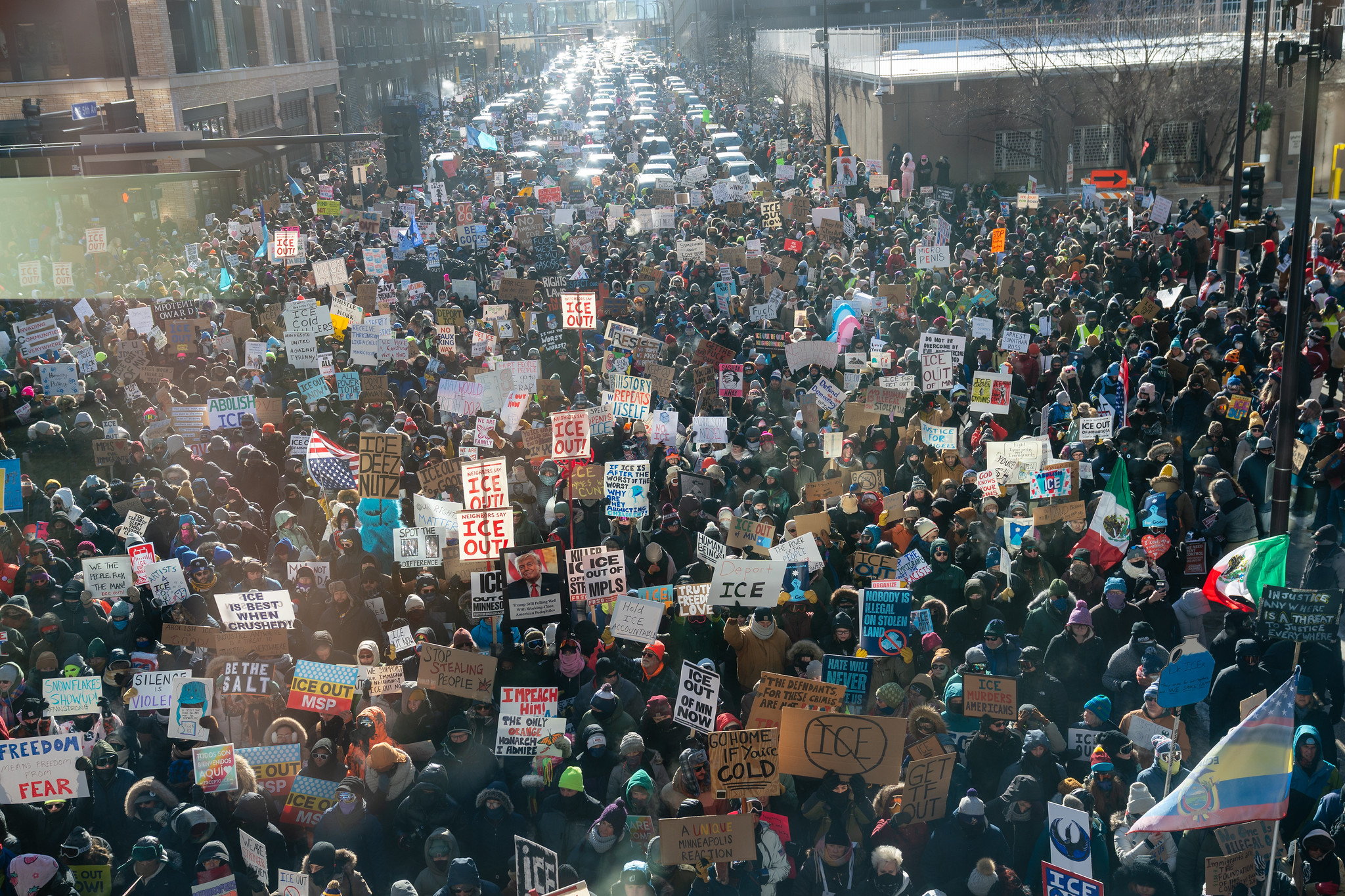
On the other side of the issue, immigrant-run businesses, like restaurants, cannot keep operating as patrons are afraid to come in, while deliveries are halted due to lack of gig workers.
The effect has been so devastating that a lawsuit against the Trump administration is already in the works, as the state of Minnesota is seeking a restraining order to stop ICE operations.
The reason: some businesses have reported a drop in sales, up to 80%.
“I’m seeing it impact everybody, just because of the lower levels of people traveling and spending discretionary income,” Adam Duininck, the CEO of the Minneapolis Downtown Improvement District told The Independent.
The situation is difficult to sustain as the state fights to resume business as usual without the disruption of protests and raids.
Is Trump Likely to Deescalate the Situation?
As of mid-December 2025, ICE held 68,440 people in detention. Nearly 75% of them had no criminal convictions, according to British newspaper The Guardian.
By January this year, CBS reported a record-breaking number of over 70,000 people being recorded in detention, according to internal Department of Homeland Security data. This would be the largest number in ICE’s history.
American tradition is deeply rooted in protecting an individual’s rights. One could argue that the ICE who say they are protecting the American way of life, have become so invasive in their procedures that they disrespect the basic foundations of what makes an American citizen.
However, ICE action, even after the recent Alex Pretti shooting, is widely supported by Republicans, so public pressure from the party that voted for the operations is unlikely.
As businesses struggle, President Donald Trump may tone down his encouragement of raids, could scale down the agency’s power and resources, but that would not change the precedent the past months have set.
As the raids continue and the state of Minnesota fights, ICE’s detention sweeps do not seem to stop and the administration only seems to encourage their strategies, which, if left unchecked, could get worse, costing more lives and violations of the American constitution.
