
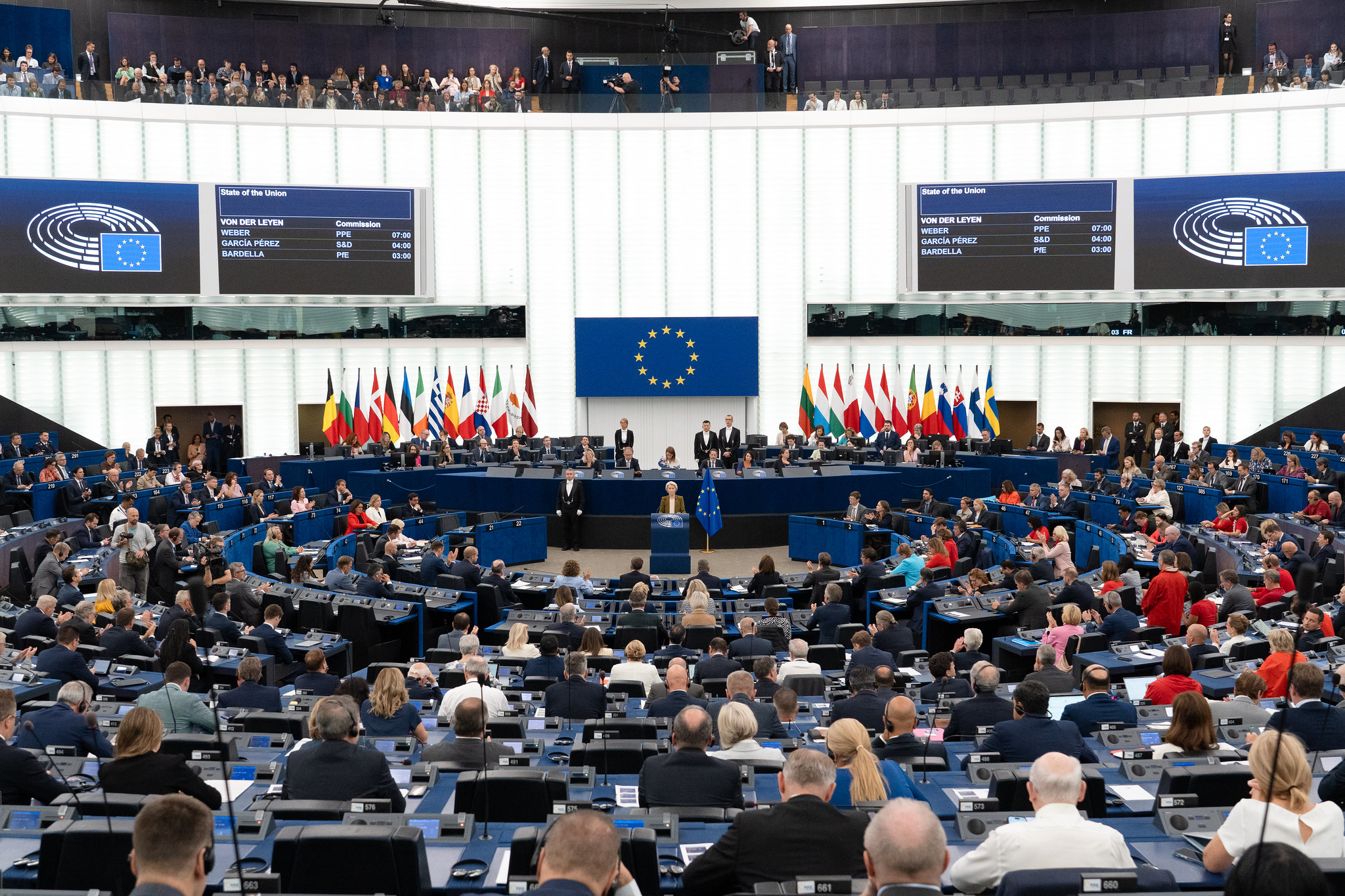
European Commission President Ursula von der Leyen gave her State of the Union Address on September 10, against the backdrop of a rapidly changing world. She touched on several policy areas that were questionable in terms of integration including asylum, returns, and border control.
“We need a system that is humane, but not naïve,” she said emphasizing the need for a Common European Return System and calling for the full implementation of the Migration and Asylum Pact as soon as possible. “It is strict, but fair. And it will only work if everyone does their part.”
What is the new policy and how does it differ from the previous attempts?
History of European Asylum Policy
The 2015 migration crisis was the first major test of European unity on the front of migration policy. Up until that point, most emphasis had been on immigration and free movement between member states, which, from the outside, depicted a largely migration-positive stance.
In terms of a common asylum policy, member states had their own procedures, but their definition of ‘refugee’ was the same under the Geneva Convention. The Dublin Convention (1997) began the process of determining which member is responsible for applications to avoid migrants ‘collecting’ them in several countries.
Internal legislation focused on emergency measures for “unexpected mass influx of displaced persons” who would require temporary protection. It required Member States to aide transit and entry states by taking in smaller numbers of refugees during redistribution efforts. Due to its controversy in the Europen Council, it has only been utilized once, after Ukraine’s invasion in 2022.
A common system for external borders was being discussed under the Tampere Program, integrating asylum policies into foreign policy by cooperating with third states.
With the Lisbon Treaty (2009), migration policy was no longer subject to unanimity but qualified majority voting but also involved the European Parliament, adding a co-legislator in addition to the Council.
Most policies were in the process of renewal when the 2015 crisis hit. The Qualification Directive, detailing the parameter of ‘refugees’ and ‘protected stateless persons’ was the only one in place by the time the first waves arrived. Others, like the first version of Eurodac, the fingerprint-based information network to aid border control, or the third Dublin Regulation, establishing which member state is responsible for handling asylum applications, were implemented with the crisis already ongoing.
The scope of the crisis brought about the European Agenda on Migration in May 2015, which set up the ‘Hotspot’ approach, involving Europol, Frontex, and the European Asylum Support Office working on the frontline to identify migrants by adding their fingerprints into Eurodac. This plan not only wanted to speed up the asylum process but aid frontline states like Greece and Italy in distributing migrants as per the Dublin Regulation.
After this, however, any legislation proposed got stuck in the deadlock machine of voting between the Parliament and the Council, as policies dealing with redistribution of migrants was met with backlash.
Policies that were already passed, did not ease the burden as each country attempted to alleviate the pressure of their own internal crises by acting on the national level. These frequently threatened other states due to Schengen borders. For example, France suspended Schengen rules and closed its borders in 2011 after Italy gave temporary permits to around 20,000 Tunisian arrivals to allow them passage to other destinations.
Later, many other states introduced border control due to the lack of control EU policies brought: Sweden, Germany, Slovakia and Austria all introduced temporary border checks. Hungary rushed to build a fence and even involved riot police utilizing tear gas and water cannons to keep migrants out.
The deadlock broke in 2020, after a prolonged crisis seemed to have subsided but the need for EU-level cooperation was clear. EU bodies agreed to create a New Pact on Migration and Asylum as “a fresh start” to deal with the major shortcomings of the 2015 Migration Crisis.
New Pact on Migration and Asylum: Fair but Strict
Though a restart of migration policies, the New Pact continues to emphasize the Dublin Regulation, which states that where the first application for protection is submitted becomes the state the refugee is registered by and should be transferred there. Dublin countries include all EU members as well as Iceland, Switzerland, Norway and Liechtenstein.
However, this new pact puts greater focus on border control instead of relying on outside partners: Frontex is to be expanded and to be present at external borders as well as in third countries, while aiding search and rescue operations at sea. European Asylum Support Office is to become the European Union Agency for Asylum (EUAA) with an enhanced mandate.
Schengen borders are also to be monitored while cooperation between interior ministries and police forces of neighboring member states will be fostered by the Council.
While the collective EU responsibility for migration management is emphasized, it puts more responsibility on coastal and border states overall with help from collective EU bodies. However, it also states that once a refugee is recognized with protection status, they should be evenly redistributed across member states to ease the burden on these frontier members.
The pact also begins the full operation of Eurodac, which will register all border-crossing individuals’ fingerprints as well as photos and identification documents. Border control will also conduct health and security checks on incoming migrants.
A common returns policy hopes to streamline the differing systems of the 27 states; a European Return Order will be in shared databases to ensure all states use the same enforcement of return decisions. Those with an order will be required to stay within the member state but given ample time for the possibility of voluntary return. If returnees fail to cooperate, their benefits can be cut, documents can be seized, and entry bans can be elongated. Detention is to be handled in specialized facilities for up to 24 months.
Return hubs will be named based on the ‘third safe country’ principle with special care that no refoulement takes place. Those posing a security risk will be identified early on and specific rules differentiate them from regular deportees.
The new pact continues to focus on international cooperation, fighting migrant smuggling in transit states like Libya, and preventing irregular departures in source countries.
Result: Unsteady Future
While the far-right rises across the continent, on the European level of governance, the new policies could bring a new level of integration that has threatened to tear the community apart for decades. Redistribution of refugees is expected to be the most difficult legislative part to pass. Should any state refuse relocation they will be expected to pay €600 million ($668 million) a year or offer logistical support.
Asylum and migration policies are vastly different and ever changing, making the new policy seem weaker with each passing day as its implementation is taking place. However, members should be keenly interested in dealing with it, not just to protect external borders but to avoid the collapse of Schengen borders, one of the greatest benefits of the Union, and to control a crisis now infecting each member on national levels.
