
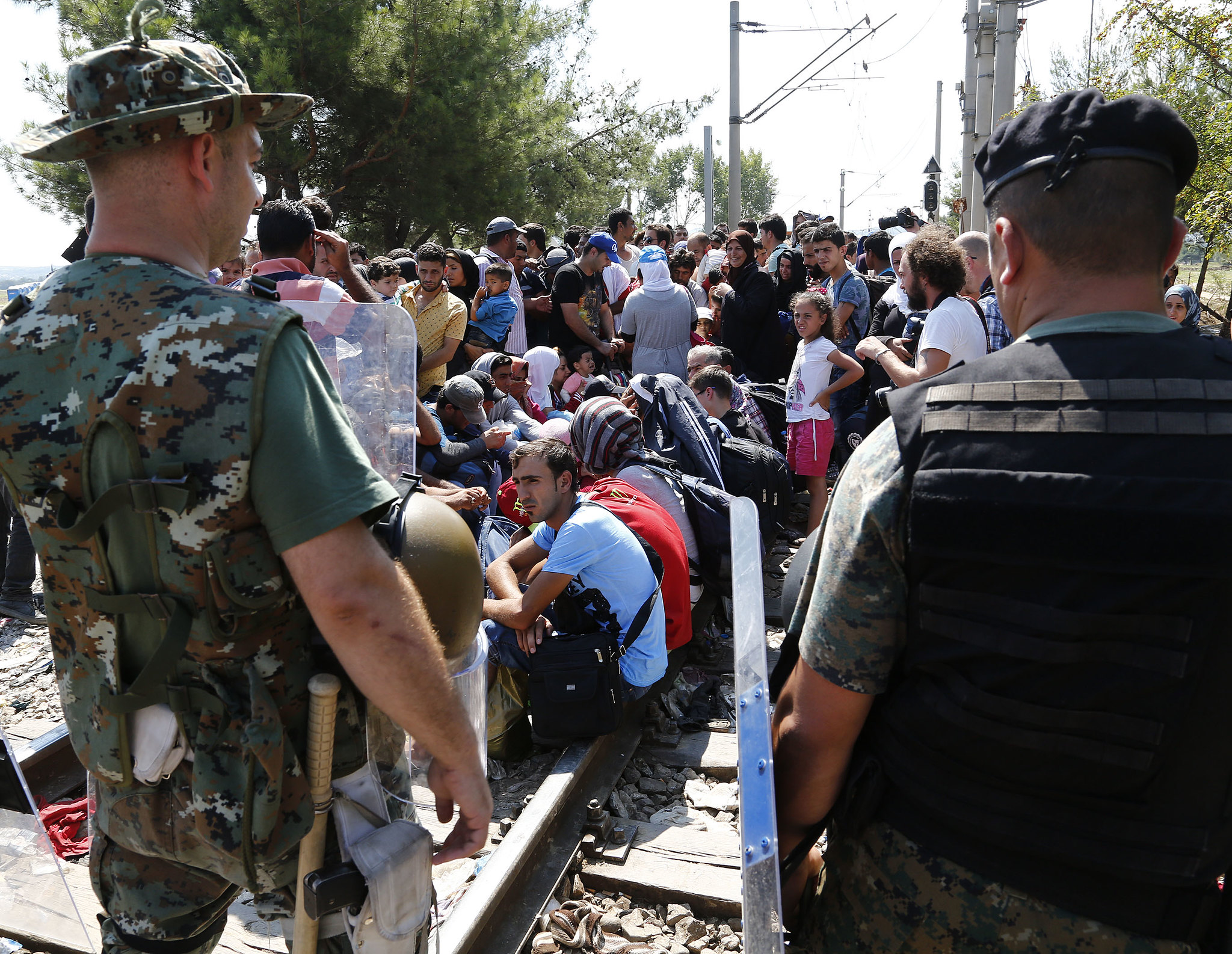
Amid global restrictions, migration remains a key issue in the Western Balkans. Along this route lie Albania, North Macedonia, Kosovo, Montenegro, Serbia, Bosnia and Herzegovina, Bulgaria, and Romania. Most migrants begin their journey in Türkiye, making their way north towards the borders of Hungary and Croatia.
The route was most frequented in the beginning of the decade, with a record 145 600 irregular crossings recorded in 2022 by Frontex, the European Border and Coast Guard Agency. Later, its numbers dwindled down as more control was exerted by countries along the parallel Eastern Mediterranean Route, especially Greece and Bulgaria.
Now, as the Mediterranean routes claim more lives than ever before, it could become the preferred alternative.
Bosnia and Herzegovina, the only state with a migration report for January 2026 published by the International Organization for Migration (IOM) at the time of writing, has reported a 26% increase this January compared to the same period in 2025.
Renewed interest could be brewing despite increasing focus from all over Europe on the area over its smuggling regimes.
Unreliable Figures Across the Region
According to the European Border and Coast Guard Agency (Frontex), the number of irregular border crossings dropped by 78% in 2024 and even further by 42% in 2025. The agency has attributed this to “stronger prevention measures” by departure states, close cooperation among member states, and a joint operation in Bosnia and Herzegovina, which began in November 2025.
Gianfranco Schiavone is the Director of the Italian Consortium of Solidarity (ICS), which partakes in the running of a shelter in the Italian city of Trieste. He says the data collected by ICS shows a very different picture from that of Frontex.
In 2024, he recorded a 10% drop along the Balkan route, compared to the over 70% Frontex released. He asked Frontex for clarification but received none. He told Info Migrants he suspects the numbers are inaccurate, as they only report those caught, not those travelling.
“The people who are working as traffickers are also now running their own centers and accommodation places along the way. And the transit times are much, much faster than they used to be. So, Frontex might think that there are fewer people than there had been, but just because you can’t see them, it doesn’t mean they are not there,” he said in late 2025.
“We are convinced that now people are still traveling the route, but in a much more ‘invisible’ manner. Because the mechanism of human trafficking has refined itself. The traffickers are more organized now.”
There are also sporadic stories that have emerged along the route: in December, Bosnian authorities found three severely frostbitten Sudanese refugees. According to Nihad Suljic, founder of the local association DjelujBa!, which assists migrants and refugees, all three had their legs amputated, with two also losing a hand.
In 2025, IOM’s Missing Migrants Project listed 21 deaths along the route in total. Three died in a boat sinking in the Sava River, separating Bosnia and Croatia. Six died after driving their cars into a lake after a police chase.
Just this February, a boat carrying migrants capsized on the Una River in western Croatia, killing at least one of the passengers. Local police reported the arrest of a Bosnian man, suspected of smuggling. They did not specify nationalities, but local news portal Index reported seven to eight Chinese nationals are believed to have been onboard.
These are not the only sources alleging smuggling to be a major contributor to the route.
A Battleground for Smugglers and Governments Alike
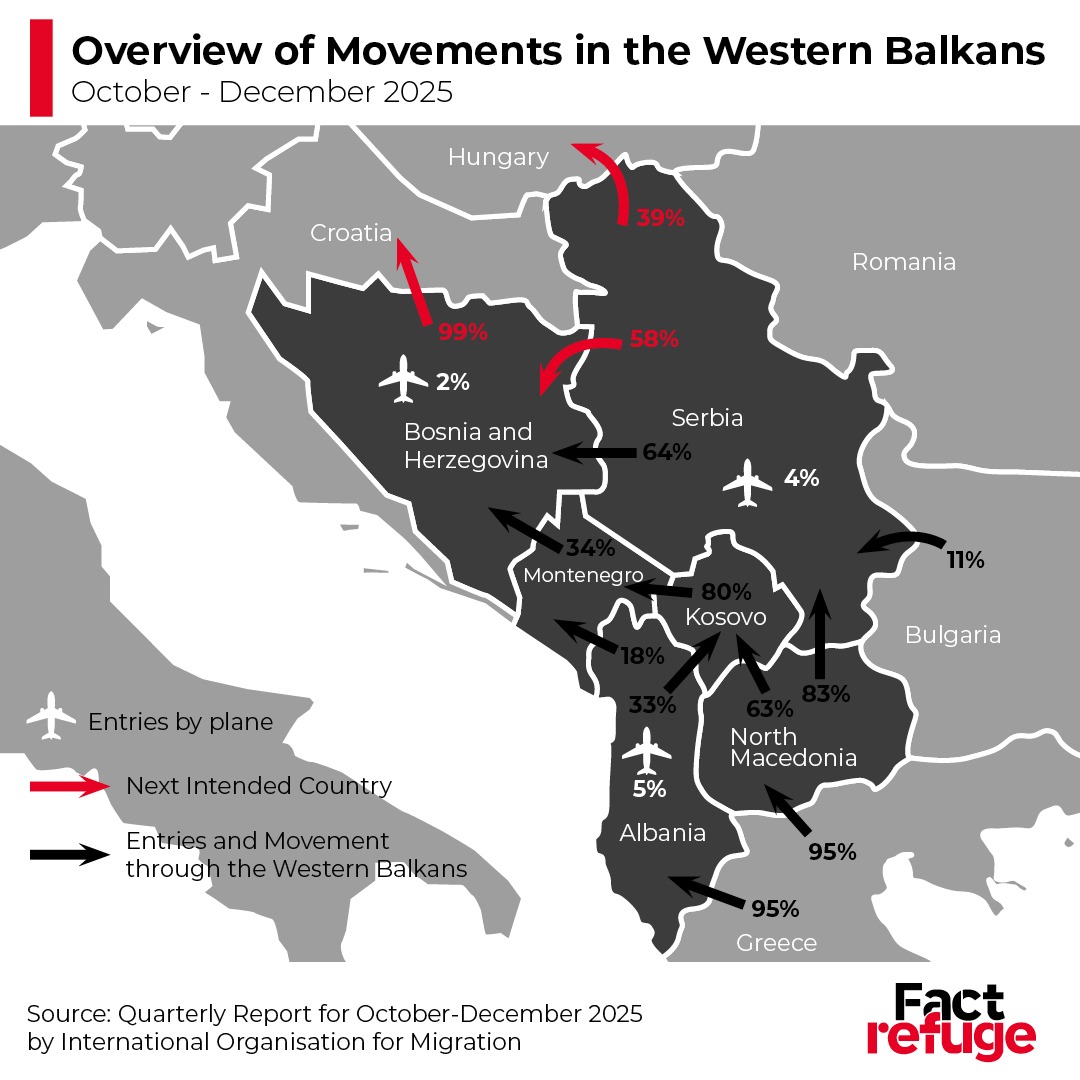
IOM surveyed 2,277 migrants for their October-December 2025 report. 65% of the respondents were facilitated by smugglers across at least one border during their journey – a journey that on average took migrants 421 days.
Authorities’ continued push for more migration control in the area is becoming a cross-continental issue as immigration debates strangle national politics: the UK government hosted a meeting with Western Balkan governments in October to deepen cooperation in an effort to tackle its small boat crisis.
The UK has a continued interest in the region: a cooperation agreement is in place with Serbia to share information and combine resources and intelligence tactics to “smash the gangs.” Kosovo received tech from UK authorities to detect drugs and weapons as well as people smuggling.
The Starmer government also invested £10 million “in innovative programs to tackle people smuggling” across the region.
Despite the attention, on-the-ground reports suggest smugglers attract not only those from the Middle East – Afghans, Egyptians, and Sudanese were the top nationalities on the Balkan route between October and December according to IOM – but also smaller numbers of faraway nations like China.
https://dtm.iom.int/reports/western-balkans-migration-routes-dynamics-quarterly-report-october-december-2025
Chinese Migrants Choose Balkans Over US
An increasing number of Chinese migrants arrive in Europe through illegal ways. Many cite the second Trump administration’s restrictive measures in the US as their reason to choose a European destination over the “walking route” to the US across Mexico.
But as Ecuador now requires a visa from Chinese nationals, the route became compromised. “Now a lot of clients are going to Europe, such as Germany, France, the Netherlands, Spain and Italy,” the Chinese proprietor of a guesthouse in Istanbul, Turkey, told Balkan Insight. He also advertises migrant smuggling services on Telegram. “It’s because going to the US is no longer feasible, so they settle for Europe instead.”
Serbia and Bosnia both allow for visa-free travel for Chinese nationals. According to Milica Svabic, a lawyer affiliated with the Serbian NGO Klikaktiv, once in the country, Chinese nationals become “completely invisible” as they can rent private accommodation.
Indeed, Chinese nationals rarely show up in route-specific reports but ranked higher than ever in asylum applications. In Germany, Chinese was the eighth nationality with the most asylum applications up until September 2025.
For many, social media draws them to Germany. Some stay there with the hopes of bringing their families over. Others, disillusioned, return to Serbia or the Middle East or even go back to China.
Besides Chinese nationals, increasing numbers of Russian refugees have also been detected across the route; 188 were recorded along the whole route by IOM.
Could the Numbers Increase?
As other migration routes become increasingly difficult, many might return their attention to the Balkans. The presence of smugglers and easier transportation means that even if migrants can’t make it to their intended destinations, they are able to find work away from their homes in these transit states.
The lack of information about local pushbacks and the “invisibility” mentioned by several sources all show that the potential is there for this route to become the next best thing as migrants grow increasingly desperate.
