

The EU has funded refugee camps and host communities in Jordan, but it’s feared more people may move in as regional tensions rise – DW.com reports.
According to the report, the Middle Eastern country hosts one of the largest refugee populations in the world, mainly from Syria, but also Iraq, Yemen, Sudan, Somalia, and others. Roughly 80 percent of refugees live outside camps — in cities and towns — and nearly half are children.
Zatari Refugee Camp
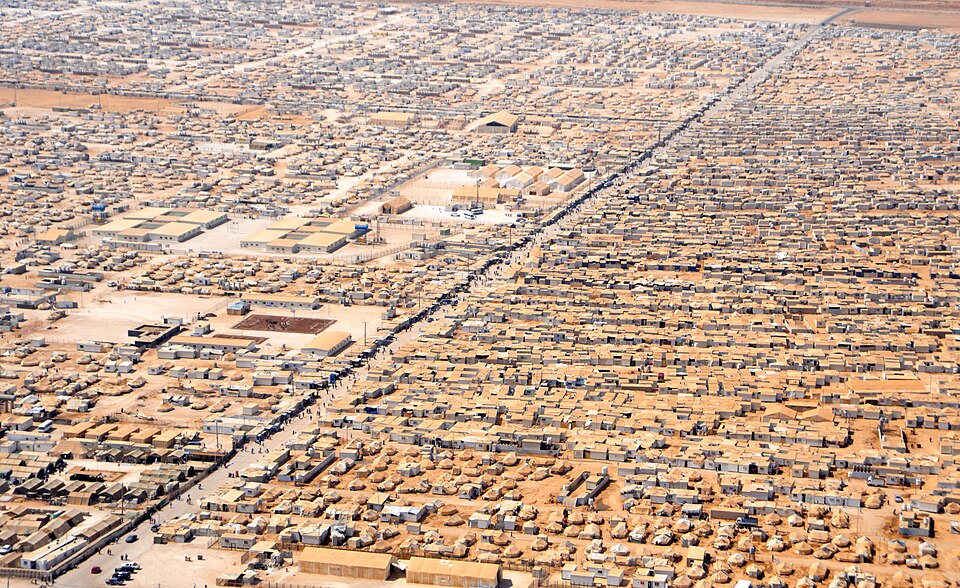
The country has four refugee camps, the largest of which is the Zaatari Camp, which is located just miles from the Syrian border. This camp was initially set up as a temporary solution for families fleeing the Syrian Civil War.
Home to almost 65,000 Syrian refugees, Zaatari camp is under the joint management of the Syrian Refugee Affairs Directorate (SRAD) and UNHCR, the UN Refugee Agency. As the lead agency for the refugee response in Jordan, UNHCR coordinates activities and services provided in the camp. Since its establishment in 2012, Zaatari has become emblematic of Syrian displacement across the Middle East. The camp’s evolution from a small collection of tents to a semi-urban settlement reflects the changing needs and aspirations of the camp residents, as well as a transition to a more predictable, cost-effective, and participatory platform for delivering assistance.
The camp is completed with nine schools ,11 hospitals, and clinics. Furthermore, there are two supermarkets as well as playgrounds and sports centers and it’s all been built in just the last four years.
As a host country, Jordan is estimated to spend $870 million a year supporting Syrian refugees; if treated as a traditional donor, it would have contributed 5,622% of its fair share. The camp is under joint administration of the Syrian Refugee Affairs Directorate and UNHCR.
The First Ever EU-Jordan Summit
EU and Jordan are made a key milestone in their long-standing relationship with a first-ever bilateral summit on January 8, 2026. Commission President von der Leyen and European Council President Costa, and King Abdullah II, reviewed the implementation of the EU-Jordan Strategic and Comprehensive Partnership (SCP), which was signed one year ago, and established future priorities.
Earlier, the European Commission approved in November an additional €80 million in funding to assist Jordan in hosting Syrian refugees and supporting affected host communities.
The new package aims to enhance social protection, provide essential services, and promote sustainable solutions for displaced Syrians in the country.
It also addresses the continued fragility of refugee communities and the decline in international funding to humanitarian programs in Jordan.
The decision includes financial flexibility allowing adjustments of up to €10 million—or 20 percent of the total allocation—to adapt to emerging needs. With the latest package, the EU’s total support to Jordan in 2025 rises to €173 million, including €93 million under the multiannual plan.
