
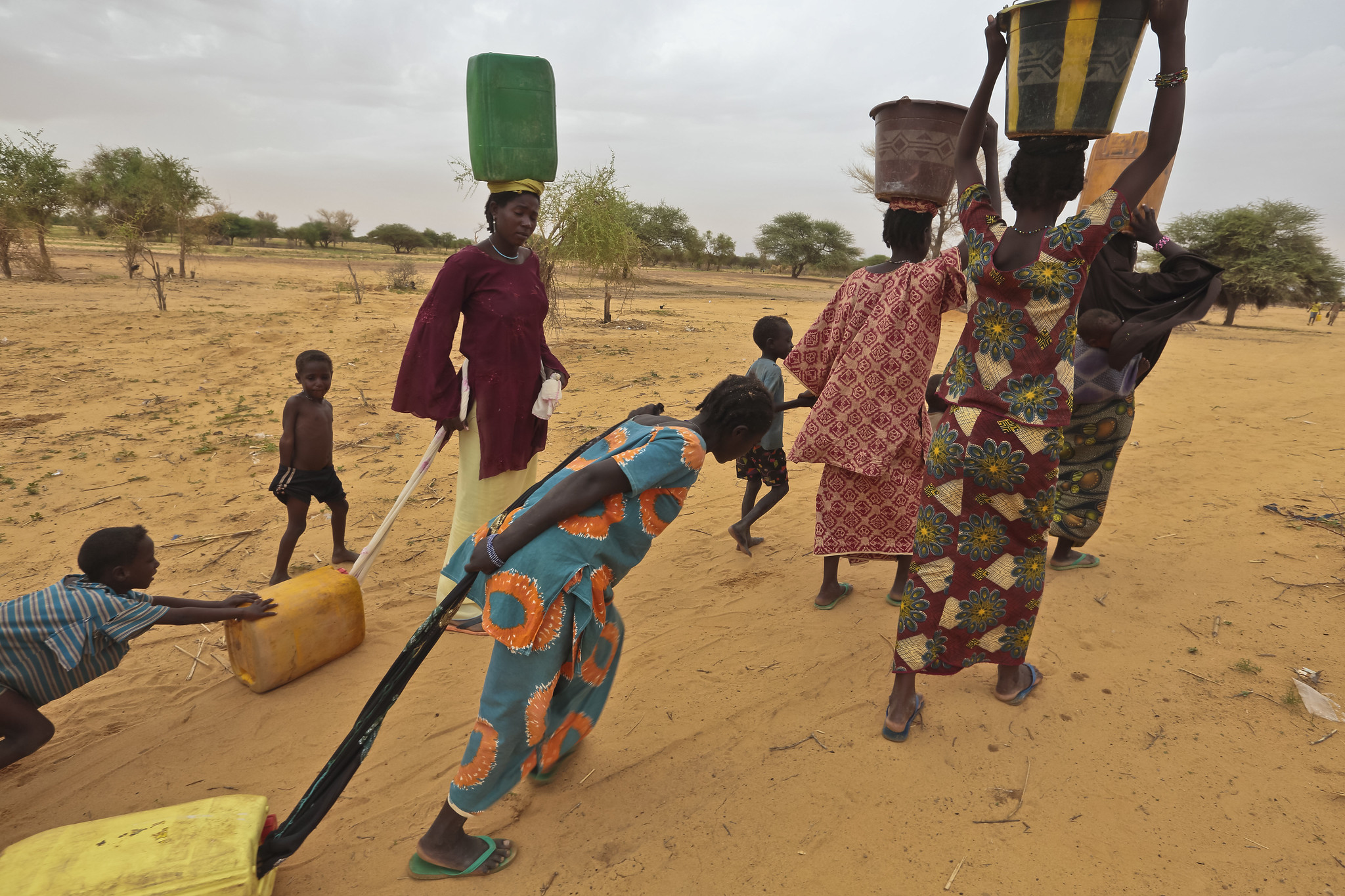
Continuous violence has led to the constant displacement of people in Mali, mostly to neighboring Mauritania. Current estimates say around 300,000 people have fled to the Hodh Chargui desert region in Eastern Mauritania with the conflict showing no signs of resolution.
The conflict between Mali’s military and rebel groups affiliated with al-Qaeda and the Islamic State group has been ongoing since at least 2012, but has evolved into a conflict involving foreign forces across the Sahel. Jama’at Nusrat al-Islam wal-Muslimin (JNIM) is currently the major al-Quada-linked force aided by the Azawad Liberation Front’s (FLA) Tuareg soldiers.
The Tuareg and Fulani communities frequently face accusations of aiding or harboring violent Islamist separatists, leading to their suffering at the hands of militants. The nomadic people are the most affected but are not the only ones, with survivors and rights groups reporting Malian and Russian forces turning violence on civilians.
Thousands Flee Instability
The country’s democratically elected leaders struggled to keep control over the impoverished region for years. Since a coup d’état in 2020, a military junta led by Gen. Assimi Goïta has been leading most of the country, promising to finish the Tuareg separatist rebellion in the north. UN peacekeepers and French forces left once the junta took over, with Russian forces coming to aid the new military government.
In 2025, analysts of the Armed Conflict Location & Event Data (ACLED) reported that the Malian military, with the Russian Wagner Group and the Africa Corps, was responsible for 918 civilian deaths. Additionally, the two main Islamist groups were estimated to have killed 232 in the same year.
“Jama’at Nusrat al-Islam wal-Muslimin (JNIM) and the Azawad Liberation Front (FLA) launched an unprecedented, coordinated nationwide offensive [in Mali,] targeting Bamako, Kati, Kidal, Gao, Sevare, and Mopti,” analysts wrote in their Africa Overview report for May 2026 at ACLED.
Recent losses represent “a major strategic and symbolic setback for the regime and its Russian partners, especially since the military and Wagner Group’s [a Russian-backed mercenary force] recapture of Kidal in November 2023 was the centerpiece of the regime’s narrative of reclaiming lost territory,” the report goes on to say.
Stability remains a distant dream, with ACLED predicting the fighting will intensify, with the Malian regime’s survival depending on continued Russian support.
The Russian Presence
The attacks in late April were some of the most serious since the militant overrun in 2012. Gen Sadio Camara, the defense minister, was killed along with his second wife and two grandchildren when a suicide car bomb exploded his home in Kati. The wave of attacks that followed threw the junta off, with reports suggesting Malian soldiers surrendering and Africa Corps negotiating corridors for evacuation. All illustrated the partial collapse of the Malian military in key areas.
Since then, AFP reported fighting “between the Malian army, the Russians and the rebels” had continued, with an AFP report saying Malian soldiers believed the Russians had betrayed them. However, Malian refugees are also suffering under the foreign forces’ interference.
AFP’s report included the story of a woman they named Cherifa, whose son was killed by Malian troops and Russian paramilitaries when he left to sell goods. She says the Malian army and the Russian fighters are “pouring their hatred on innocent, defenseless people.” A Tuareg herder, referred to as Nedoune, described how Russian soldiers tied him up while they burned his fields, killed his animals, and beat him.
“They pour water on your body, then put wires in your ears and send an electric current until you pass out,” he told AFP. “They always asked about jihadists: Do you know them? Who are they? Where are they?”
Nedoune was only released after paying around 550 dollars (around 474 euros) as ransom.
30-year-old Fatima said that though she was able to flee, she worries for the women left behind in Mali: “Everything happened to them except death … we know some were tortured,” she told AFP. “Before the Russians came, we lived in peace.”
Doctors Without Borders (MSF) also corroborate stories of torture, as they see the injuries at the border town of Fassala. “We have testimonies of torture, including people who say they were buried alive,” said local MSF coordinator Mayoury Savant. “We also see sexual violence, affecting both women and men,” she added.
Change is Far Away Yet
As the fighting rages on, experts do not anticipate its resolution anytime soon. Various rights groups continue their case against the crisis with the African Union, seeking justice for the abuses allegedly committed by Malian and Russian soldiers in recent years but are also expecting slow results.
Meanwhile, Mauritania continues its pushbacks, further endangering Malian refugees to stop migration towards Europe.
