

Refugees and migrants who travel through the vast desert regions of southern Libya—especially along transit routes from Sudan, Eritrea, and elsewhere—are increasingly falling into the hands of organised traffickers rather than just smugglers – CNN reported. Once captured, they are held in remote camps or abandoned desert locations with minimal oversight.
In those camps, detainees live under horrendous conditions: chained or locked up, exposed to torture, beatings, sexual violence, starvation and forced labour. Their phones are often confiscated, or if allowed, used by the traffickers to call the victims’ relatives and demand ransom payments—sometimes in the thousands of U.S. dollars—under threat of further torture or even death.
The geographical remoteness of the Sahara desert helps traffickers operate with relative impunity: security forces have limited reach, the terrain is vast, and the number of informal money-transfer networks (such as hawala) facilitates ransom transactions across borders.
Libya has a deeply entrenched “ransom-based human trafficking” system affecting hundreds of thousands of refugees and migrants. Victims are abducted, sold or transferred, and once families pay, detainees may be released or moved on—but not necessarily safely.
Hawala System—Big Business for Traffickers
Hawala, an ancient method of money transfer originating in South Asia, enables the movement of funds without the physical transfer of currency. Known for its reliance on trust rather than official promissory notes, it operates outside traditional banking systems, particularly benefiting those in regions with limited access to formal financial networks. By facilitating swift, cost-effective remittances, hawala serves as an alternative remittance channel, especially for migrants and expatriates. However, its unregulated nature also attracts illicit activities, leading many countries to impose strict regulations or outright bans.
In Libya, at the northeast corner of the Sahara Desert, its vast wilderness marks the final leg on the African continent for those fleeing war, persecution, and lack of opportunity in search of a better life. Recently, the vast majority have been coming from Sudan, embroiled in a brutal civil war which has displaced millions. Much of it is relatively functional—insofar as clients pay several hundred dollars to be transported in bare-bones conditions to Libya’s coast and onto an overcrowded inflatable dingy bound for Italy or Greece.
If his family doesn’t manage to gather the $10,000 being demanded by his captors, he may soon be dead. If someone comes from a country perceived to have a large diaspora – wealthy, at least compared to everyone else – then they stand a good chance of falling into the hands not of smugglers, but of traffickers, who coerce and exploit those in their control.
For families, the experience is traumatic: being contacted by terrified loved ones, confronted with video or audio evidence of abuse, scrambling to gather large sums of money (often sacrificing savings, selling assets, borrowing), and living with fear for the victim’s survival.

Migration Situation in a Troubled Country
Migration in Libya is two-fold; there are Libyans arriving in Europe fleeing the conflict of their own state, and there are migrants from various other states utilizing Libya as a stop on their journey to Europe.
While the migrant population in Libya has grown steadily, this has not translated into sustained increases in departures. For migrants who do not intend to move onward from Libya, this means tighter controls, as well as an accumulation effect with war-driven arrivals, especially Sudanese, adding to the migrant stock without immediately moving onward. The primary countries of origin continue to be Sudan, Niger, Egypt, Chad, and Algeria.
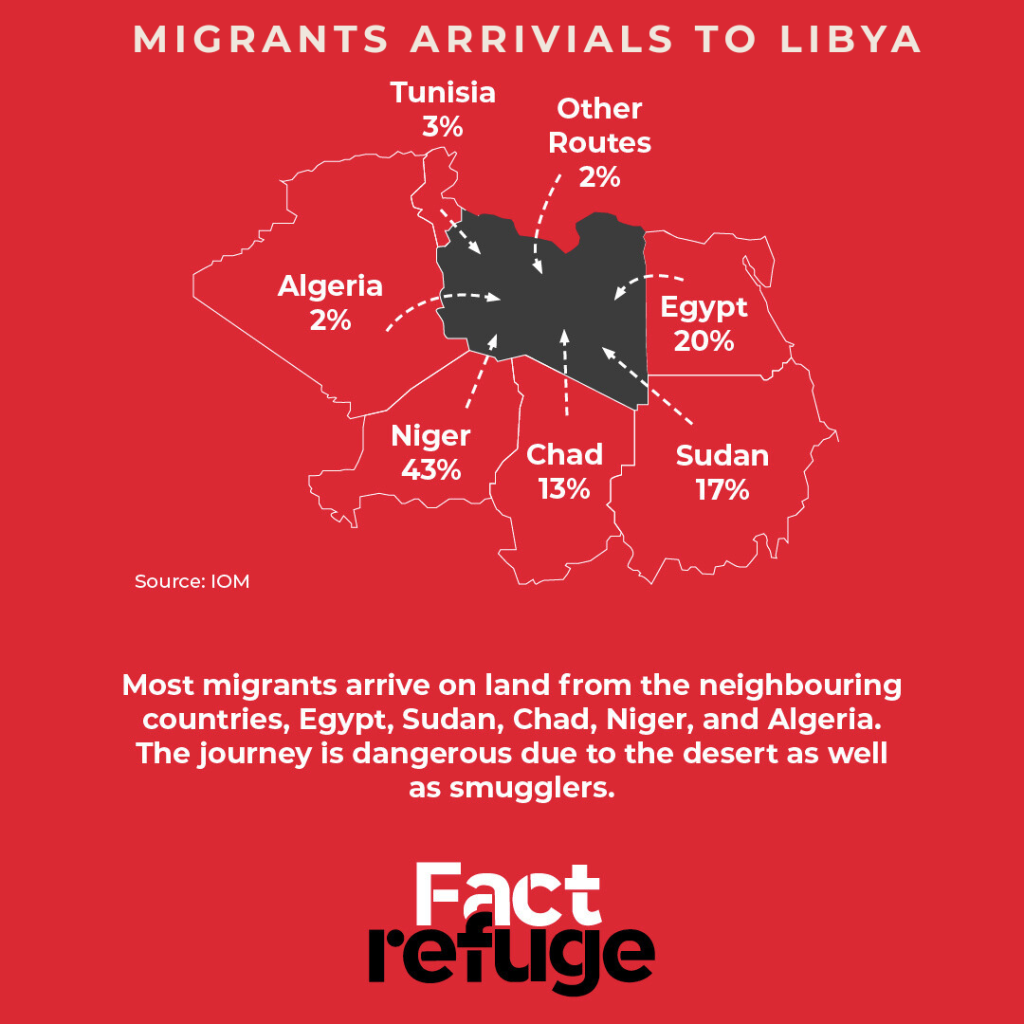
From a policy perspective, the challenge is enormous: multiple armed groups, militias and smuggling networks are involved; state governance is weak in southern Libya; international cooperation is patchy; money flows are opaque; and migrants in irregular status are especially vulnerable, with limited access to protection or legal recourse.
According to a spokesperson for the UN Human Rights Office, there are several abuses committed against migrants in Libya, such as forced labor, extortion, torture, starvation in appalling conditions, mass expulsions, and the sale of human beings.
Libya and Tunisia have become the most sought-after destinations for migrants from sub-Saharan Africa in recent years. The European Union, which aims to stop the flow of migrants across the Mediterranean Sea, counts both nations as partners.
The UN reports that there are at least two mass graves in the nation: one was recently found near the border between Libya and Tunisia, and the other was discovered in the al-Jahriya valley in March of this year, with at least 65 bodies discovered there.
