

More than 200 Ethiopians are estimated to be facing death penalty in Saudi Arabia due to drug-related offenses after they fled their home country in search of a better life.
“These are not isolated cases,” Maya Foa, chief executive of human rights group Reprieve, explained to CNN World. “There is a clear pattern of Saudi authorities targeting vulnerable migrants. Often, their true ‘crime’ appears to have been crossing the border, in search of a better life.”
Most recently, several dozen prisoners were able to get ahold of the mobile phone number of the BBC’s Tigrinya language service to reveal more about their desperate situation.
Charges and Incarceration
Habtom, a prisoner whose name has been changed by the BBC to hide his identity, has been held in jail in the southern city of Khamis Mushait for over three years. He, and most other prisoners the BBC spoke to, was found guilty of smuggling hashish, a type of cannabis, a crime that can result in a death sentence at the discretion of the judge.
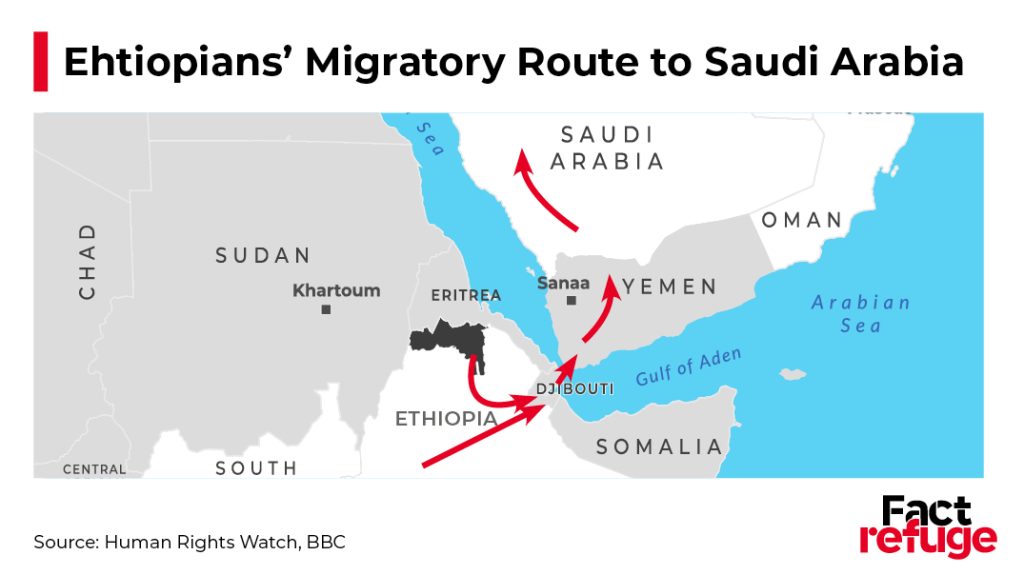
He wanted to finish high school, go to college, and get a job to support his parents, but the Tigray war made that impossible. “My goal was destroyed, so I decided to emigrate,” he said. He took the dangerous journey from Ethiopia to Saudi Arabia in 2021 and found a low-paying job as a goatherder. Later, his employers offered a chance to earn more money by delivering packages. When he was stopped by police, they found the narcotic leaf known as “khat,” a natural stimulant widely used in the Horn of Africa.
“I did not know what we were carrying. But later I was told it was khat. I don’t even know what khat is,” Habtom said, admitting that he began the work because of the money it offered.
Though the Saudi authorities refused to comment when asked by the BBC, every execution is accompanied by an official press agency statement outlining the process of getting the sentence: an investigation, a court case, an appeal, a Supreme Court ruling, and then a royal decree.
However, according to human rights groups like Reprieve, Human Rights Watch (HRW), and Amnesty International, these cases rarely follow due process: many are given no access to a lawyer or their court papers or proper translation of those papers, all of which are needed to file an appeal.
“There is a near-total lack of transparency throughout the entire judicial process, from sentencing to Supreme Court review and ratification by the King. People on death row and their families are left in the dark about their fate,” Amnesty International researcher Dana Ahmed told the BBC.
Habtom himself says he never had the chance to speak to a lawyer or defend himself and was forced to sign a document that was in Arabic, in which he agreed to his sentence without understanding what that meant. Other prisoners shared similar stories with the BBC.
Three men interviewed by HRW reported similar treatment: brief group court hearings, lack of lawyers, and nobody informing them of the charges at any point. Travelling through the dangerous route across the Gulf of Aden, they said they felt compelled to carry khat to make money and survive. In one case, sources said a smuggler forces a man to carry the plant from Yemen as a condition for facilitating his crossing.
Official Saudi press agency statements stated the sentences reflect commitment to protect “from the scourge of drugs.”
Targeting Ethiopians?
Two years ago only two Ethiopians faced death penalty, according to Amnesty International, compared to 35 deaths in 2025. While the reason behind this increase is unclear, some say it could be linked to the uptick in Ethiopians emigrating after the devastating effects of the Tigray Civil War, which ended in 2022, made life increasingly difficult.
“It may also be linked to Saudi Arabia’s expanding use of the death penalty for drug-related offenses in recent years,” Ahmed reasoned.
This year already shows a potential to continue the trend: three Ethiopians were executed and at least 65 were at imminent risk of execution as of April, according to HRW.
“Saudi Arabia’s willingness to execute foreign migrants for nonviolent offenses following trials that denied them basic due process reflects a profound disregard for their rights and lives,” said Nadia Hardman, senior refugee and migrant rights researcher at Human Rights Watch. “Saudi Arabia’s partners should urgently intervene before it is too late.”
HRW has documented longstanding human rights violations in the detention of migrants in Saudi Arabia. In 2023, they reported at least hundreds of Ethiopian migrants and asylum seekers being killed at the Yemen–Saudi border, which, if it were a part of Saudi policy to murder migrants, could account for a crime against humanity, according to the organization.
“Saudi Arabia’s extensive use of the death penalty is intertwined with fundamental and systemic violations of defendants’ rights to due process and a fair trial,” Hardman said. “The death sentences should be commuted and the death penalty abolished.”
Prisoners Send for Help
“I’m a dead man walking,” Amanuel, another prisoner on death row, told CNN. “After my friends were executed, I don’t eat food, I don’t drink water.” Executions in Saudi Arabia arrive without warning. Without a last meal or farewell call.
Families learn of arrests through word of mouth, not Ethiopian or Saudi officials. “What I’m praying for, and what I need from the world, is to put positive pressure on the Saudi government to reconsider this decision,” said Selam, a sibling of one of the men, using a pseudonym to protect their family. “Please, Saudi government, we beg your mercy to my brother and others in a similar situation.”
Desta, another prisoner, told the BBC that he shared a cell with 200 men. “The guard only opens the door to bring food, covering his mouth and nose with a mask – that is the only time the door is opened. After he gives us the food, he quickly locks it and leaves.”
He expected to be returned home after serving some time, but after being forced to sign Arabic documents, he was also sentenced to death.
In a statement written to CNN last month, Ethiopia’s Ministry of Foreign Affairs said it maintained “regular communication and constructive engagement” with Saudi authorities, adding that 1,971 Ethiopian nationals have “benefited from royal amnesties,” though it was unclear whether these were drug-related sentences.