
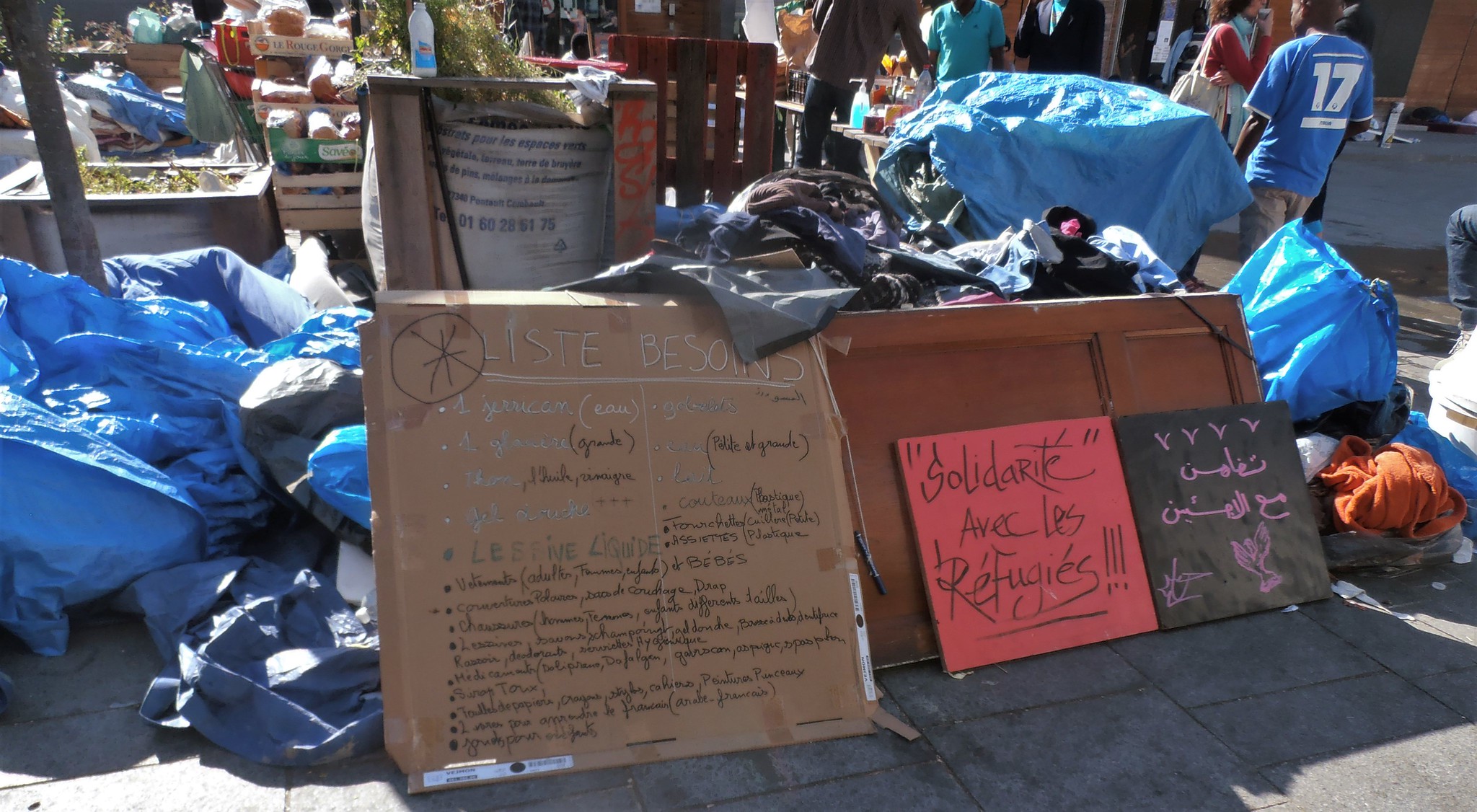
Beneath the Parisian Metro’s Line 2 near Stalingrad station lies the last historic informal settlement overlooked by the local authorities. Over 800 migrants, primarily from Sudan, Eritrea, and Afghanistan, call this place home. Humanitarian associations say that “police harassment” has diminished recently, but migrants still need proper housing.
Each migrant resident is at a different point in their journey: there are “Dubliners” awaiting their asylum decisions from the countries they first arrived at, those with rejected asylum requests who cannot be deported due to their nationality, and even officially recognized refugees. Others are passing by on their way to Calais, hoping to reach the United Kingdom.
A “Historic” Camp
Dozens of tents make up the small settlement in Northeastern Paris, between La Chapelle and La Villette. The camp is the oldest of its kind in the capital.
“It’s a historic place. Migrants were already here ten years ago,” said Yann Manzi, founder of the Utopia 56 association, regularly distributing tents and blankets throughout the camp. “After arriving in France, you go to La Chapelle. It’s a place deeply rooted in people’s journey to exile.”
“Say you are from Afghanistan, Sudan or Eritrea… You arrive in France to request protection, you won’t find a welcome center. You end up here in sordid conditions,” said Paul Alauzy, coordinator at Doctors of the World (MdM), who runs a mobile clinic to treat migrants on the street.
Currently, the camp consists of tents, makeshift shacks, dilapidated sofas, and mattresses. This is the last tolerated settlement since the city pursues a policy of “no permanent settlements,” making it the police’s responsibility to dismantle emerging camps.
“Despite the cold drafts and the smell of urine, it’s still better than back there,” Mohamed Omra, a refugee from Abu Hamad, a city in northern Sudan, told Le Monde in 2025. In his home country, he worked as a driver, but he constantly worried about the ever-present drones targeting him while driving.
“When I was in Italy, they told us we had to come here because there are a lot of Sudanese,” explained Yasser Yahia, another Sudanese resident.
In 2025, Le Monde’s report referred to the area as “Little Sudan” as the neighborhood was home to shops, grocery stores, hair salons, and Sudanese restaurants on Rue Philippe-de-Girard and Rue Pajol streets. Most were run by political refugees who fled the Darfur war in 2003. This solidarity is said to attract many.
“If it hadn’t been for the war, Sudanese people would never have known France,” argued Yasser Youssif, 31, who had lived in Paris for eight years.
Slow Changes
In 2020, relocations were frequently enforced, pushing migrants as far as the Saint-Denis suburbs. Preparing for the 2024 Olympic and Paralympic Games, humanitarian organizations accused the government of carrying out “social cleansing” as they relocated migrants from the capital and its surrounding areas. According to the Revers de la Médaille collective, 42 camps were dismantled between May and July in 2024.
MdM documented over 400 eviction operations in informal Northeastern Parisian settlements over the next ten years.
Despite this, the settlement near Stalingrad Station has remained overlooked, with police operations slowing down recently, never having carried out any large-scale operations in this settlement.
“The police used to come every morning to tell us to leave. Now they just come to see the situation in the camp, but they don’t say anything to us anymore,” said Ahmed Ibrahim, a 22-year-old Sudanese man who has been homeless for three years since his asylum application was rejected.
State-organized “relocations” take migrants to centers, but many refuse to go. Bureaucracy forces others back onto the streets after only a few days, leading them to resettle in the same camps. “I went to centers twice, but after two weeks they told me to leave, so I always come back here,” said Ahmed Ibrahim. “It’s not as bad as before,” said Alauzy.
A New Center?
The new mayor of Paris, Emmanuel Grégoire of the Socialist Party (PS), has promised solutions, having visited the Stalingrad camp twice since being elected to meet its residents and the associations aiding them. In an interview with Le Parisien, he said he was “ready to create large accommodation centers.”
“We hope that the promises made during the municipal elections will be kept and that the government will move quickly to break this vicious cycle of informal living spaces,” said Alauzy.
