
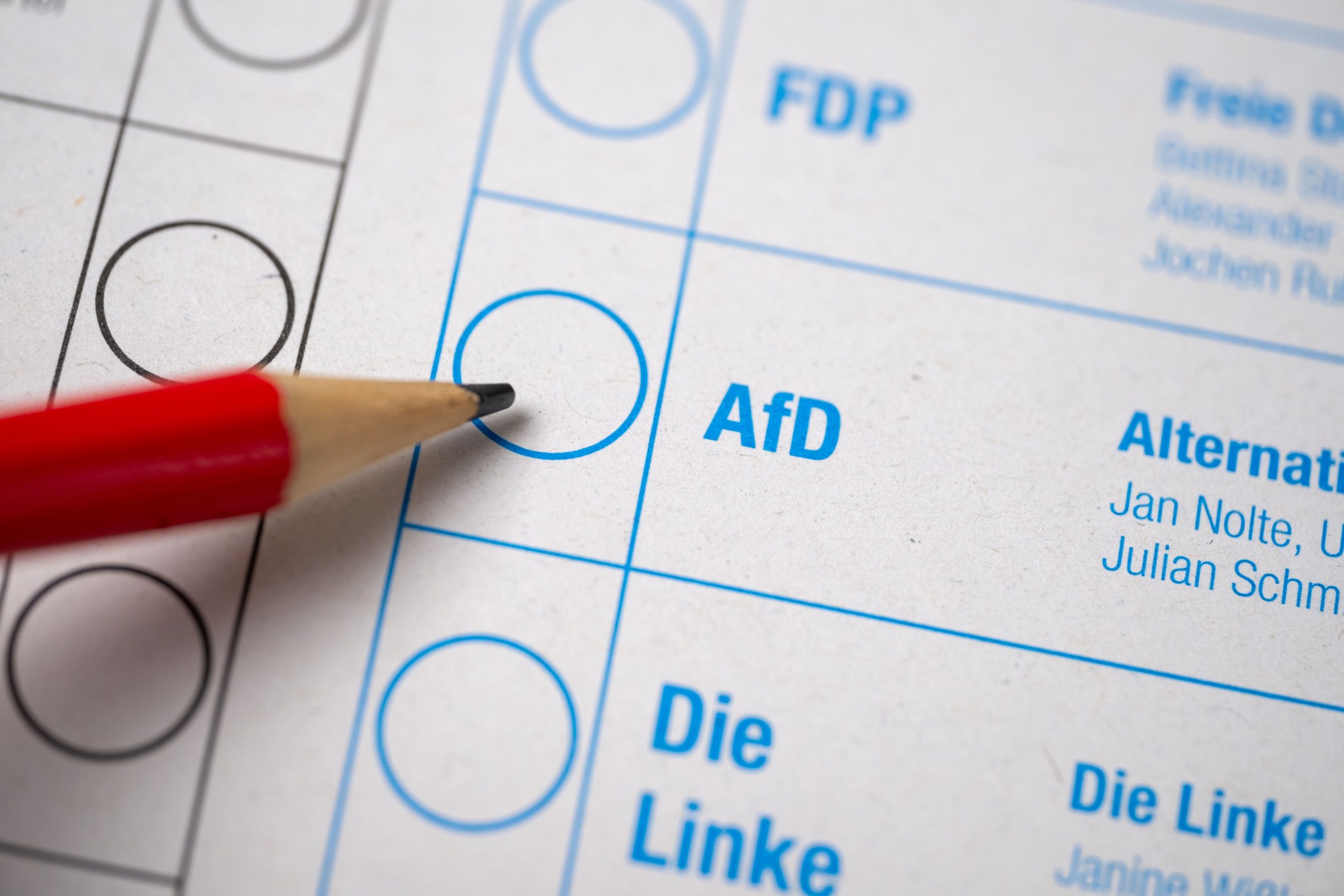
The far-right Alternative for Germany (AfD) has achieved a massive win of 43.8 percent in the state election of Saxony-Anhalt in East Germany on September 6. The historic moment represents the strongest win ever achieved by a far-right party since the Second World War.
For the party specifically, it means falling just three seats short of an absolute majority in the state parliament but winning double the vote share of the governing Christian Democrats (CDU).
Chancellor Friedrich Merz has called local election defeats a “disaster” after, as in the northeastern state of Mecklenburg-Vorpommern, the CDU failed to reach the five percent threshold to enter parliament. The AfD was on track to win the election here as well but is expected to fail in forming a coalition to govern.
The historic change worries refugees and civil society groups especially, as the AfD is set to restrict access to education and work, while ratcheting up detentions and deportations.
Fear and Exclusion Require No Government
Doubts remain about the extent to which the AfD can implement their policies without achieving a majority government. There is a possibility to form a minority government, in which case the division of powers between the federal and state levels would limit them. In coalition with Sahra Wagenknecht Alliance – Reason and Justice (BSW), who have offered cooperation on policy issues, the AfD could form a majority government, though BSW’s lead candidate Claudia Wittig told CORRECTIV at the end of August that when they addressed the question, “The answer has always been no.” The AfD itself has always stated that their policies could only be achieved by governing alone.
The AfD’s strong views on migration are likely to influence public demeanors. “Our concern is that a policy based on deterrence, control, and exclusion would make everyday life much more uncertain for many people,” Saaeid Saaeid, spokesperson for the SaxonyAnhalt Refugee Council, told InfoMigrants.
“This would affect not only possible changes to legislation but also the atmosphere in public authorities, accommodation centers, schools, workplaces, and public spaces.”
The culture of exclusion and fear is everywhere: Christian Democratic Union of Germany (CDU) politician Reiner Haseloff was Minister-President of Saxony-Anhalt since 2011, stepping down in January 2026. Working in Magdeburg, the state capital, he told German news portal Spiegel that he often felt “as though I were in the final phase of the Weimar Republic’s Reichstag, or later in Berlin’s Sportpalast” while sitting in the state parliament.
Refugees feel similarly in public life. Around 150 migrant shops took part in a “Migra-Strike” to protest racism and show what they believed would happen to them should the AfD form government. According to InfoMigrants, many considered leaving for fear of attacks and a sudden feeling of insecurity regarding the future.
Segregation on Multiple Levels
The AfD proposes several aspects of segregation: on one level, it demands the decentralization of refugee accommodations, to move them from city centers to large reception centers, diminishing their chances of taking part in everyday life.
The AfD program also involved creating “special classes” for children with temporary refugee status to address language barriers and prepare them for possible returns. Speaking to InfoMigrants, Karl Kopp, Europe director of refugeerights organization Pro Asyl, said the idea crosses a line.
“Children would be judged not by their educational needs, but by their parents’ origins. ‘Permanent special classes’ are clearly unlawful.”
Additionally, while the individual right for asylum and international returns arrangements are federal-level policies, an AfD government would have control over implementation. Saaeid points out that individual politicians and state governments have sway with state authorities that would coordinate education, funding, and initial reception. Kopp agreed, adding that “an AfDled administration could delay decisions, harass people seeking protection, and create maximum pressure.”
Compulsory Work and Deportations
Deportations are another tricky subject in terms of state versus federal authority: a state government does not decide who has the right to asylum or residence. It does, however, prioritize deportations and manages the budget and staffing. It can also put pressure on municipalities to cooperate, according to InfoMigrants.
Despite this, the AfD would introduce state-level deportation task forces that would carry out “deportation from minute one” if a migrant lacks residence permits. Looking at US practices, says Kopp, it becomes clear how “deportation authorities can become instruments of authoritarian deterrence.”
The AfD also put forward the idea of compulsory work for asylum seekers, essentially to work or undertake community service in exchange for state support and under threat of being sanctioned if they fail to do so.
“First excluding people from the labor market and then obliging them to work creates a discriminatory special law,” according to Kopp. As Saxony-Anhalt struggles with higher unemployment than the national average, their entrance to the labor market and quick legalization could aid the state’s economy.
What Can Be Done?
The AfD also plans to abolish democracy and civic engagement programs, when many call for these to monitor the oncoming situation.
Kopp himself calls on fellow human rights organizations to not give in to fear. “We need strong refugee councils and initiatives like victim‑support organizations. And of course we have to forge strong alliances with churches, trade unions, and committed municipalities. Together, we are defending an open, democratic migration society.”
“Together with initiatives in Saxony‑Anhalt, we have to act on several levels…and, above all, protect those affected in practice.”