
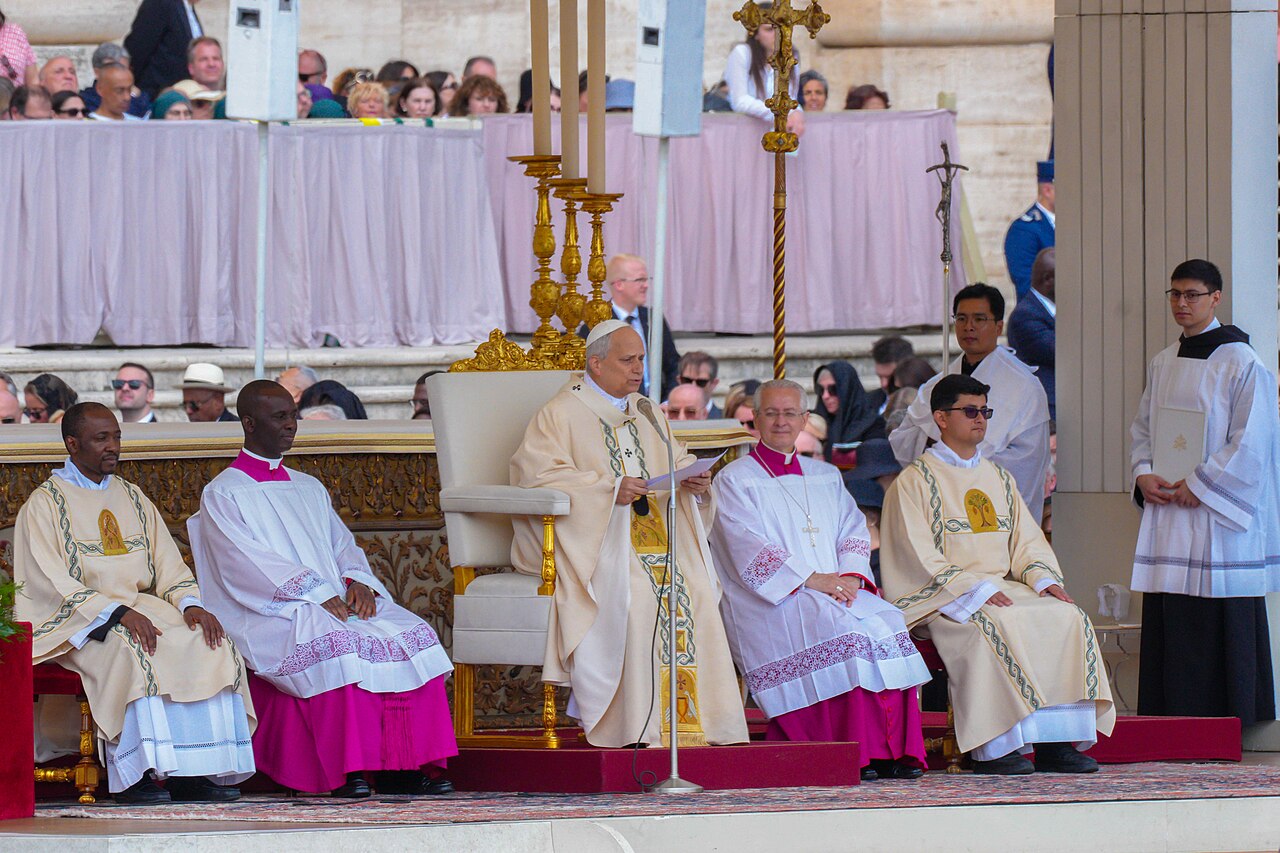
Pope Leo XIV’s April 2026 apostolic journey to Africa—covering Algeria, Cameroon, Angola, and Equatorial Guinea—marks a defining moment of his early pontificate.
The 11-day tour, started this Monday, represents a strategic intervention in some of the most pressing global issues: interreligious coexistence, post-colonial inequality, conflict, and especially migration.
Meanwhile, Donald Trump has delivered an extraordinary broadside against Pope Leo XIV, saying he does not think that Leo “(is) doing a very good job” and that he is “a very liberal person”, while also suggesting the pontiff should “stop catering to the radical left”.
In response, Leo, told reporters on the papal flight en route to to Algiers that he did not fear the Trump administration and would continue to speak out against war.
Trump’s remarks have been criticized by Italian politicians from across the spectrum, from Matteo Salvini, to Matteo Renzi. Even Italian PM Giorgia Meloni stood up for the pontiff.
Africa as the New Center of Gravity
Leo XIV’s decision to prioritize Africa reflects a profound shift within global Catholicism. The continent now accounts for more than 20 percent of the world’s Catholics and represents the fastest-growing region of the Church.
His Holiness’s itinerary – stretching from North Africa to sub-Saharan regions – symbolically bridges Algeria (the land of St. Augustine) and the Church’s future demographic and spiritual vitality beyond the Equator.
During this mega trip, the Pope is attempting something ambitious: to speak about migration not as a slogan but as a consequence of a broken global order.
Interreligious Dialogue, Inequality, and Migration and the Catholic Church’s Answers to Them
As the first pope to visit Algeria, Leo XIV places Christian-Muslim dialogue at the center of his mission. Beyond Algeria, in Cameroon, Angola, and Equatorial Guinea, the leader of the Catholic Church has to face separatist violence, resource inequality and authoritarian governance.
Yet Leo treated them as variations of the same problem. War, corruption, and economic exclusion are not isolated crises—they are the forces that push people to leave.
These stops reveal a consistent theme: the Church positioning itself as a moral actor in fragile states where political institutions are weak or contested.
Migration: Between Compassion and Realism
Migration emerges as one of the central threads of the trip. North Africa, particularly Algeria, is a key transit zone for migrants attempting to reach Europe, making it a symbolic entry point for the Pope’s reflections.
Leo XIV consistently emphasizes that migration is not a random phenomenon but the result of systemic errors; it is not the disease but the symptom.
While maintaining a humanitarian tone, Leo XIV introduces a more balanced—and in some respects more cautious—approach than his predecessor. Leo acknowledges something many political and religious leaders prefer to avoid: migration, if unmanaged, creates real strain. Social systems, political stability, and public trust can all be affected. Ignoring that reality, he suggests, is as dangerous as denying migrants’ humanity.
Leo XIV’s approach can be summarized as a three-part framework: ethical imperative, political realism and structural responsibility
Migrants must always be treated with dignity and compassion. Violence, humiliation, and dehumanization are categorically rejected. States retain legitimate authority over borders. Migration must be governed, not romanticized.
The global community must address root causes—conflict, inequality, and environmental degradation—rather than merely managing consequences. This synthesis positions Leo XIV between progressive humanitarianism and conservative sovereignty concerns, potentially reshaping the Church’s influence in migration debates.
