
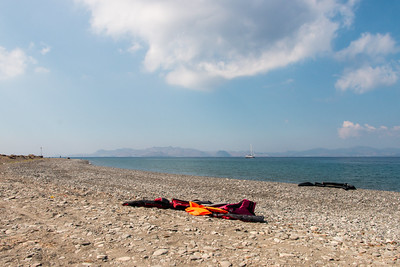
The “EU-Turkey deal” was signed in March 2016, amid a sharp increase in the number of people arriving in the European Union in search of safety and protection. Officially called the “statement of cooperation,” the accord aimed to prevent the large groups of migrants departing from the Turkish coast for Greece and Europe.
A Successful Blueprint for the EU Migration Policy?
Ten years after the EU-Turkey migration agreement, outcomes reveal a deeply mixed legacy: while irregular migration flows into the EU were sharply reduced, the deal’s humanitarian consequences and democratic costs remain fiercely contested.
The so-called Facility for Refugees in Turkey was set up in 2016 and granted €3 billion to assess the need of both refugees in the country, in the context of the crisis.
For the period of 2021-2027, the EU has allocated almost 5.5 billion euros in support of refugees and host communities in Turkey, as wells in Turkey’s capacity for border management.
The European Commission, in its official 2026 review, acknowledged the deal’s “contributions to reducing illegal migration” and its role as “a framework of cooperation on migration on the Eastern Mediterranean route”.
Yet, the Commission’s own audit body, the European Court of Auditors, reported in March 2026 that “corruption and mismanagement of funds in Turkish detention centers remain systemic.”
The Court considered that the €3 billion purse that the EU provided the Turkish authorities with “appropriately addressed the main needs of the refugees” in the area in a timely manner.
However, neither the European Commission nor the European Court of Auditors
were able to identify the beneficiaries of two cash-assistance projects for refugees which account for almost half of the budget.
were able to identify the beneficiaries of two cash-assistance projects for refugees which account for almost half of the budget.
The Humanitarian Side of the Deal
The deal indeed led to the decrease in the number of irregular arrivals, according to statistics released by the United Nations High Commissioner for Refugees (UNHCR). Arrivals by sea to the Greek islands in the Aegean Sea fell in the years following the agreement: 30,000 migrants reached the Green islands by sea in 2017, compared to 173,000 in 2016.
The number of irregular arrivals later fluctuated between 2017 and 2025, without ever reaching the same level that existed from 2015-2016. For example, 42,000 migrants arrived irregularly in Greece by sea in 2025, while 54,000 arrived in 2024.
As civil organisations repeatedly warned, “thousands of asylum seekers have been trapped in conditions of prolonged uncertainty, with devastating consequences for their physical and mental health.”
On Lesvos alone, the population of confined people exceeded 20,000 in early 2020, living in conditions widely documented as inhumane and degrading. Between 2016 and mid-2020, at least 26 people lost their lives within the camps on the island, deaths directly linked to the conditions of their containment.”
Beyond statistics, the EU’s externalization strategy has become a blueprint for other regions. The IOM note in its 2026 report that the EU-Turkey deal “has served as a model for subsequent agreements with Libya, Tunisia, and Egypt, creating a “global system of offshore detention hubs”.
Access to healthcare and legal aid remains inadequate. The OECD’s 2025 report emphasized that “the Turkish government has used the deal to justify suppressing dissent under the guise of “counter-terrorism”. The deal, in effect, created a new form of political leverage — one that rewards authoritarian behavior.
The EU’s continued funding of Turkey, despite documented human rights abuses, reveals a fundamental contradiction: the EU’s commitment to human rights is increasingly conditional — not on outcomes, but on political convenience.
The deal, which has been hailed as a success by the Commission, has come at an enormous human cost over the past decade. “Thousands of people continue to face inhumane conditions, and European leaders are celebrating 10 years of policies that caused chaos and mistreatment,” stated Christin Psarra, General Director of MSF Greece.
In practice, it fundamentally reshaped the EU’s migration policy by introducing a model centered on deterrence, containment, and the externalisation of asylum responsibilities beyond EU borders.
Photo: Ann Wuyts/flickr.com
