
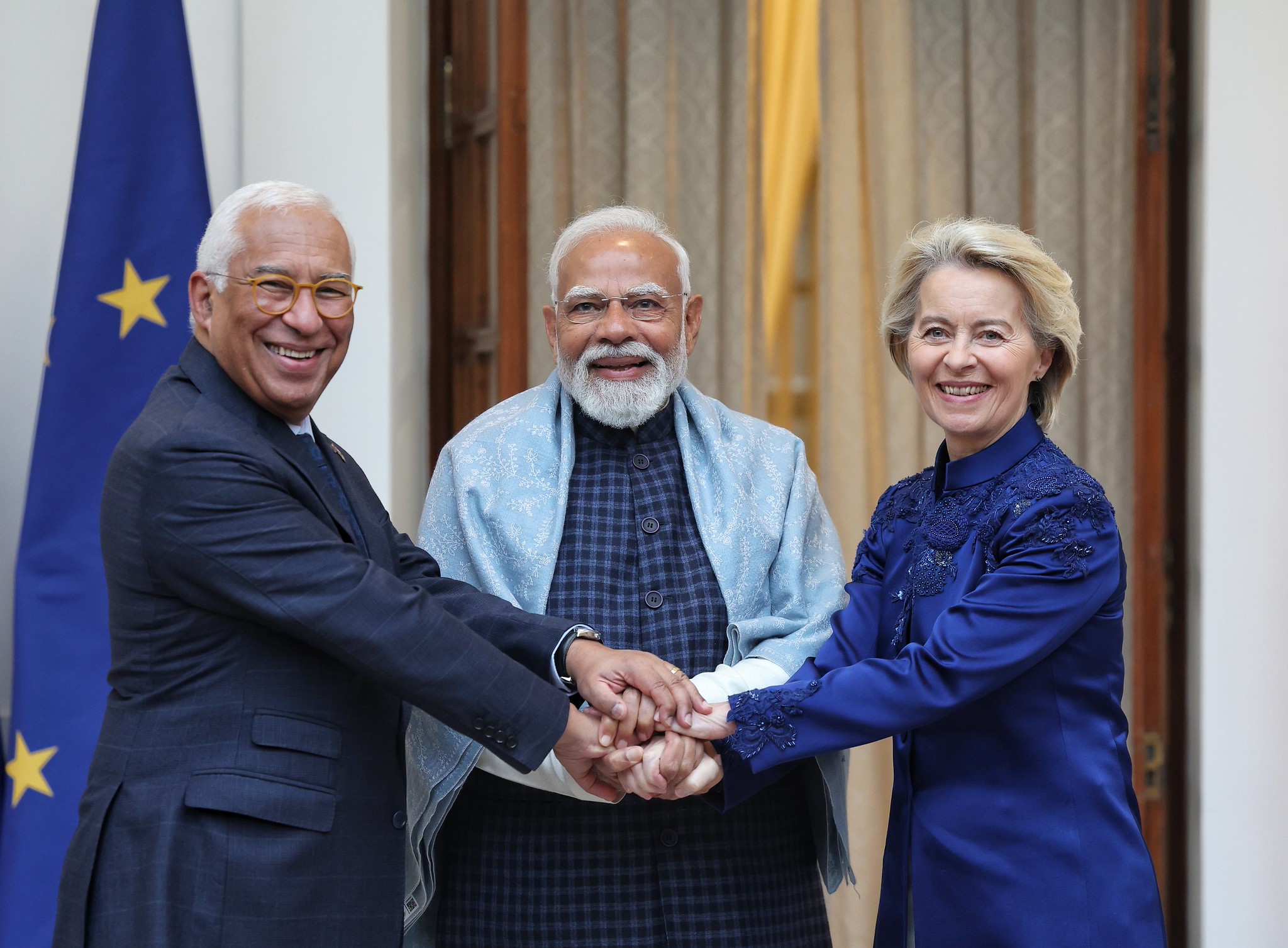
“We did it, we delivered the mother of all deals,” European Commission President Ursula von der Leyen told reporters enthusiastically at a briefing in Delhi, India last week, announcing the landmark trade deal between the European Union and India.
There were many issues on the negotiation table, including a Security and Defence Partnership, a Trade and Technology Council (TTC), and advancing climate and biodiversity action within the United Nation’s framework.
The most important aspect, however, is the Free Trade Agreement, that was negotiated for almost two decades before its finalization at the end of January.
What Does the FTA Cover?
The Free Trade Agreement (FTA) covers two massive economies: the world’s biggest population and an economic giant of 27 European states together make up roughly 25% of global gross domestic product and a market of two billion people.
It involves the elimination of certain tariffs after phased reductions, like EU exports of chemicals, machinery and electrical equipment, providing “preferential access” into the EU for Indian exports, and significant reductions on tariffs overall. Duties on motor vehicles, currently 110%, are expected to be cut to 10% under a 250,000 quota.
Trade between the two partners already involves goods and services worth €180 billion per year, supporting almost 800,000 EU jobs. The “most ambitious trade opening that India has ever granted to a trade partner” is expected to provide the EU with a major advantage over other partners.
The Migration and Mobility Aspect
The FTA also includes a mobility framework to allow easier movement of researchers, students, seasonal and highly skilled workers. However, while trade is an EU competence, allowing the Commission to negotiate on behalf of member states, the matter of mobility and visas is a shared competence, so this aspect of the deal must be approved by individual member states before fulfilling its agreements.
The India-EU Comprehensive Framework of Cooperation on Mobility seems to be treated similarly to a Memorandum of Understanding; it is yet to become law but is a commitment to pursue further talks with concrete plans to pursue.
The Pact aims to help workers moving between the two giants to comply with both countries’ legislation, reaffirming “commitment to enhancing collaboration on safe, regular and orderly migration.”
The deal also capitalizes on the more than dozen bilateral deals already in place between India and several EU member countries, such as France, Germany, and Italy, hoping to streamline rules across the bloc.
As part of the pact, the first European Legal Gateway Office is to be launched in India to help facilitate Indian talent in moving to Europe in an orderly and legalized manner, while the digitalization of Schengen aims to quicken visa procedures while combating visa fraud. The plans also include making full use of the EU’s Talent Pool IT platform, which will prioritize and facilitate the recruitment of workers in occupations of shortage.
The two partners also vowed to continue cooperation on irregular migration, outlined in the EU-India Common Agenda on Migration and Mobility in 2016, to counter human smuggling and trafficking.
Researchers and Students
To enhance research cooperation, the agreement involves exploring “options for association of India to Horizon Europe” to collaborate with Indian researchers on “equal footing.”
Research in the fields of digital, energy, water, agrifood, health, semiconductors, biotech, advanced materials will be deepened through co-funding mechanisms, while collaborative research will focus on artificial intelligence (AI), quantum, advanced semiconductors, clean tech and biotech.
This begins with students: programs like the EU’s Erasmus+ and Indian funding programs like the Scheme for Promotion of Academic and Research Collaboration (SPARC) will facilitate the exchange of students and academics alike.
An Education and Skills Dialogue is to be launched this year to promote skills development and aid the mutual recognition of qualifications, establishing satellite campuses, and expanding language training in India.
On the human level, the mobility scheme proposes the reduction of overall limitations: for instance, there would be no cap on the number of Indian students who can study in EU countries, and their visa would allow them to move between member states.
According to reports from Indian news agencies, a new framework in the FTA would allow a guaranteed window of at least 9 but up to 12 months to Indian students of EU institutions to seek employment, ensuring integration.
Forbes reports about ambitious plans to fast-track visa processing so that 90% of Indian nationals applying for student and researcher visas could receive their papers within 30 days. Furthermore, work permits granted upon graduation from recognized programs would allow 3 instead of 2 years in Europe.
While negotiations continue, the ratification and implementation of the new measures will take years, since the Indian, EU, and member state parliaments all must be involved. Though little is known about the mobility pact in general, it is a plan that would greatly benefit both parties, especially with the FTA implemented.
The Context: Trump’s Restrictive Policies
The agreement comes amid growing pressure from US President Donald Trump who, in his crackdown on immigration, has continued to make it stricter and more expensive for Indians to enter the US.
Most notably, he increased the expenses of the widely popular H1-B visa to incur a $100,000 fee for new applicants, to be paid before the application is submitted. The visa program was dominated by Indian nationals, especially in the technology sector. The change aimed to incentivize hiring American workforce instead of relying on overseas laborers.
“The opening of an EU Legal Gateway Office is a timely and welcome move, particularly as traditional student destinations such as the US, UK, Canada and Australia tighten immigration pathways, recalibrate post-study work regimes and raise compliance thresholds,” Dhruv Krishnaraj, co-founder and director of Student Circus, a job search platform for international students in the UK, Ireland, Australia, Germany and Canada, told the Business Standard, India’s leading daily business newspaper.
Leaders seemed to agree as they each hailed the deal as “A strong message that co-operation is the best answer to global challenges” and an “important political message to the world that India and the EU believe more in trade agreements than in tariffs.”
Should this mobility scheme be put into action, it would mean the most populous nation in the world has a direct and preferential path to the EU, granting them a way out of restrictive measures they face in other states.
